SaaS has long celebrated a 3x LTV/CAC
This heuristic, first popularized by David Skok, has become the default for measuring the health of a SaaS company's go-to-market engine. At around 3x, growth is considered efficient and sustainable. As the ratio falls below that level, businesses require progressively more capital to grow, making the economics less attractive.
In reality, consistently achieving a 3x LTV/CAC ratio is difficult, which is why it has become something of a "benchmark" for excellent SaaS businesses.
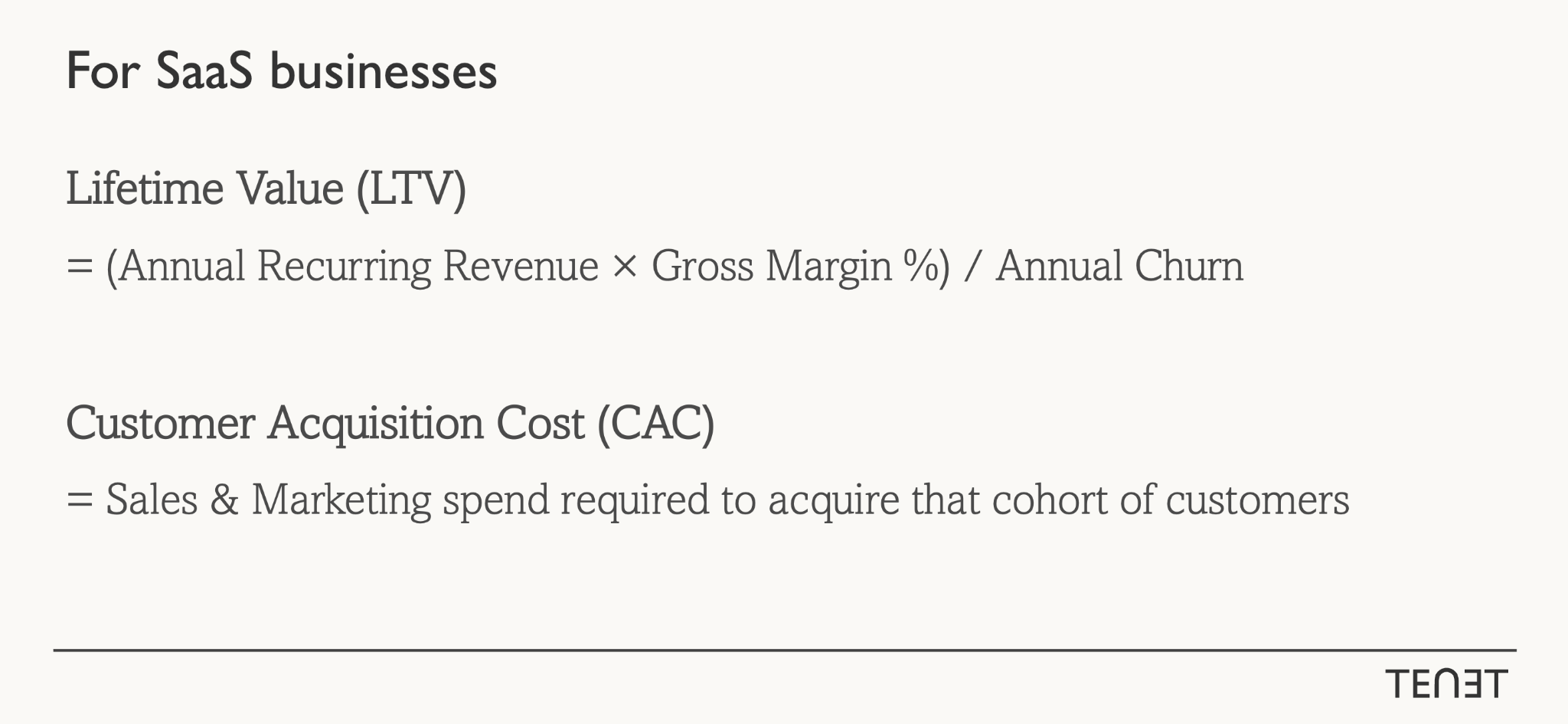
The calculation itself is straightforward:
As someone obsessed with AI Roll-ups, I was wondering how those businesses fare on the LTV/CAC metric?
To answer this question, we first need to adapt the formula to the reality of AI Roll-ups.
1. Re-defining LTV/CAC for AI Roll-ups
SaaS companies (primarily) scale organically through direct/PLG/partner-led customer acquisition, while AI Roll-ups scale through a combination or organic customer acquisition and M&A + AI transformation. So the LTV/CAC metric does slightly different things for SaaS businesses vs AI Roll-ups.
For SaaS companies, it estimates the lifetime value of a cohort of customers, and compares it to the (Sales and Marketing) cost of acquiring them. Usually, this cohort is defined by a combination of a time-period (e.g. Q1 2025) and a channel (e.g. direct sales). For AI Roll-ups, LTV/CAC should serve the same intent, but the cohort of customers is the entire book of business acquired from one M&A transaction.
1a. Calculating Lifetime Value (LTV)
The core concept of calculating LTV remains the same - estimate the economic value generated by a recurring stream of revenue for a cohort of customers. The ideal way to define this economic value is some measure of profitability - for SaaS, that measure is Gross Margin. It is directly related to a customer cohort and it is what ends up paying for the CAC (Sales & Marketing costs), and also for R&D, and HQ expenses (G&A). For AI Roll-ups, we believe EBITDA is a better measure. The economic stream acquired through an M&A is the [Gross Margin - SG&A] (i.e asset EBITDA). That's what ends up justifying the acquisition price, and also HQ-level expenses like R&D, and HQ team.
Note: A prudent reader would point out that comparing EBITDA for AI Roll-ups and Gross Margin for SaaS isn't exactly apples-to-apples, and they'd be right. While calculating asset-level EBITDA, you also count the acquired business's salespeople as a cost, whereas SaaS pushes those costs into CAC. We've deliberately left these inside EBITDA rather than moving them up to TopCo/HQ. This does mean the LTV calculated here is slightly suppressed - but I'd rather err on the side of being conservative. In any case, adjusting for it doesn't change the final outcomes meaningfully.
The fundamental premise of an AI Roll-up is that AI can automate a meaningful portion of COGS (typically 30%+). Since EBITDA = Revenue − COGS - SG&A expenses, successful AI transformations also improve EBITDA Margins.
Therefore, rather than using today's EBITDA, we calculate LTV using the post-transformation EBITDA, since that better reflects the economics we expect over the lifetime of the acquired customer relationships.
Note: The EBITDA here is the asset-level EBITDA before any central TopCo costs (such as the shared technology platform, AI engineering teams or headquarters functions), since those costs support the broader platform rather than any individual acquisition.
Note: Just like the traditional SaaS formula, this should be viewed as a simplifying approximation rather than a full discounted cash flow analysis. Similar to any LTV framework, this formula also collapses a complex retention curve into a single expected churn assumption. In practice, services businesses often experience lumpy retention around founder transitions or integrations rather than smooth annual decay, but the simplified formulation is sufficient for comparing broad unit economics.
Our adapted formula therefore becomes:
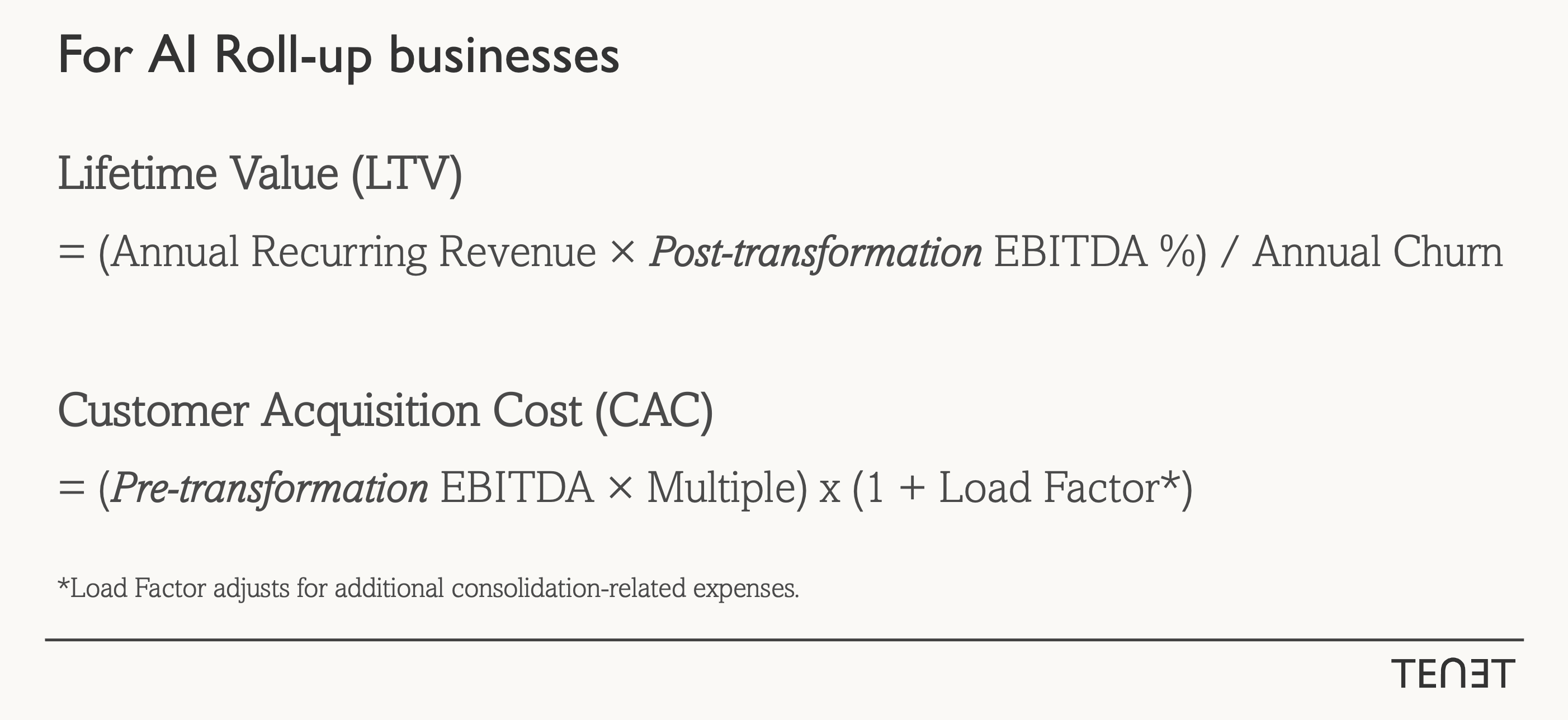
LTV = (ARR × Post-transformation EBITDA Margin %) / Annual Churn
Where ARR = Annual Re-occuring Revenue
Note: Services firms usually have "re-occuring" revenue (e.g. bookkeeping / tax filing / customs declarations at fairly consistent frequency) instead of "recurring" revenue generally used in ARR definitions. This formula implicitly assumes that (a) revenue remains largely re-occuring, and (b) we can estimate it accurately.
1b. Calculating Customer Acquisition Cost (CAC)
The formula sees a meaningful departure from the SaaS version here.
Instead of using S&M expenses, the relevant measure for AI Roll-ups is the cost of acquiring the entire business; because M&A is a key mode through which customer relationships are acquired.
Clearly, an acquisition buys much more than customers - it also includes employees, brand, contracts, licenses and other assets. So this is not the same definition of CAC used in SaaS. I'm intentionally adapting the framework to better reflect the realities of an acquisition-led business model. For simplicity, let's also assume the acquired business has no excess cash or debt (which is usually adjusted while calculating the Acquisition Price).
That means:
CAC = Acquisition Price = Enterprise Value
EV for services businesses is usually calculated using an EBITDA multiple. So that gives us,
CAC = Enterprise Value = EBITDA × Acquisition Multiple
For smaller service businesses, acquisition multiples typically range from roughly 2–5x EBITDA.
One important nuance is that the AI transformation happens after the acquisition. Therefore, CAC is calculated using pre-transformation EBITDA, while LTV reflects the economics after transformation. This asymmetry is precisely what creates investment returns: you acquire a business based on today's earnings while creating value through future operational improvements.
Enterprise Value (EV) = Pre-transformation EBITDA × Acquisition Multiple
In reality, you also need to incur some additional acquisition-related costs (e.g. legal, due diligence) and integration costs. Depending on the size of the acquisition, these usually end up being between 5-10% of the EV. To make our estimate robust, let's add a 10% loading on the EV to account for these expenses.
CAC = EV + Acquisition and Integration Expenses
So our final formula becomes:
CAC = (Pre-transformation EBITDA × Acquisition Multiple) × (1 + Load Factor)
The "Load Factor" here is simply 10%.
2. Simulating LTV/CAC for AI Roll-ups
2a. A typical services business - pre-transformation
Let us first apply this formula to an acquisition of a typical white-collar service business.
The image below shows the P&L of a representative example.
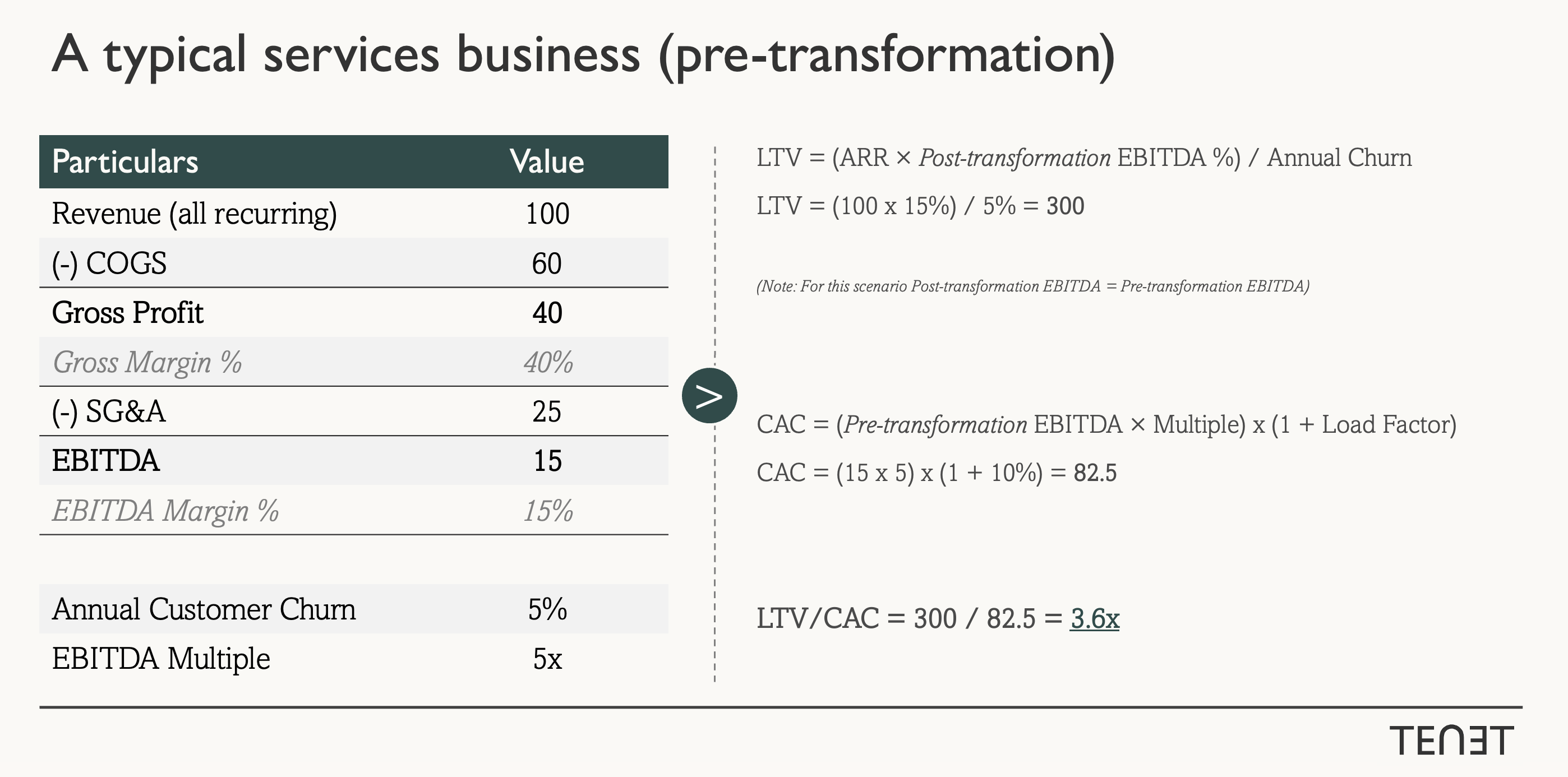
Applying our adapted formulae to this business shows something very interesting:
A typical M&A transaction already beats the 3x LTV/CAC threshold even before the AI transformation!
This looks great on paper, but it comes with an important caveat: without AI transformation, these economics are difficult to scale. Every additional dollar of revenue still requires proportionally more employees. If ten tax professionals serve $2 million of revenue, you'll likely need twenty to serve $4 million, forty to serve $8 million, and so on. Very quickly, organisational complexity (which grows exponentially, not linearly to scale) becomes the limiting factor. Many owner-operators deliberately choose not to keep growing because managing increasingly large workforces becomes disproportionately difficult.
Now let us look at how AI transformation affects this equation.
2b. Impact of AI transformation
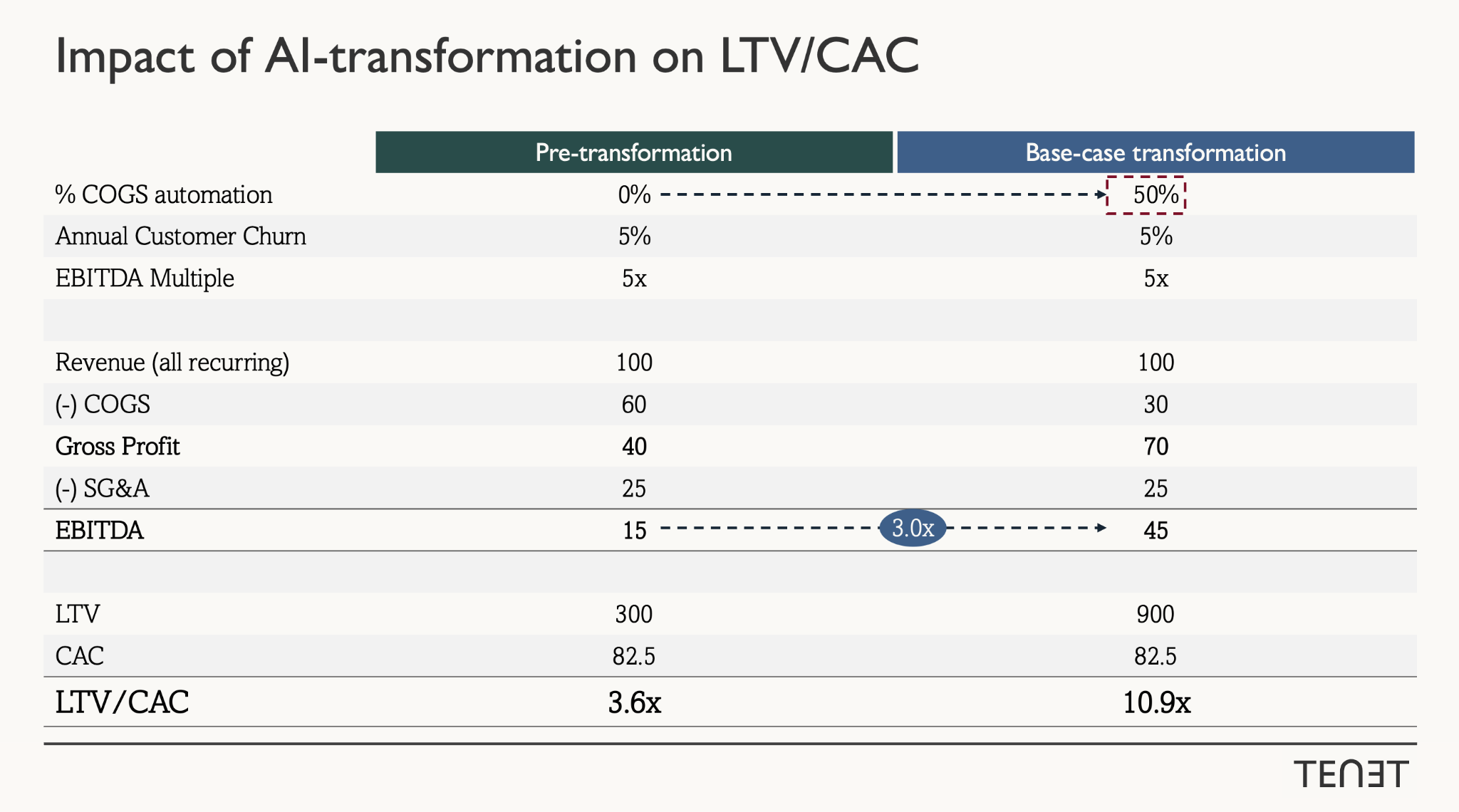
For the same business, let's assume AI transformation can reduce labour-related COGS by 50%. As the below chart shows, that productivity flows directly through the P&L increasing Gross Margin to 1.75x and EBITDA to 3x!
Our LTV now becomes:
LTV = 100 × 45% / 5% = 900
CAC remains unchanged at 82.5, because we purchased the business before the transformation.
Giving:
LTV/CAC = 10.9x. The rarest of the rare in SaaS-land!
The above figures are not a work of fiction: They are based on actual results delivered by AI Roll-up pioneers across 100+ acquisitions! We can call them the "Base case" scenario.
But for the sake of intellectual rigour, let's tone down these assumptions significantly.
2c. Impact of (conservative) AI transformation
Let's reduce the COGS automation from 50% to the lower-end (30%), and also let's increase the annual revenue churn to 7% assuming there is heavy drop-off of customers during the integration and transformation.
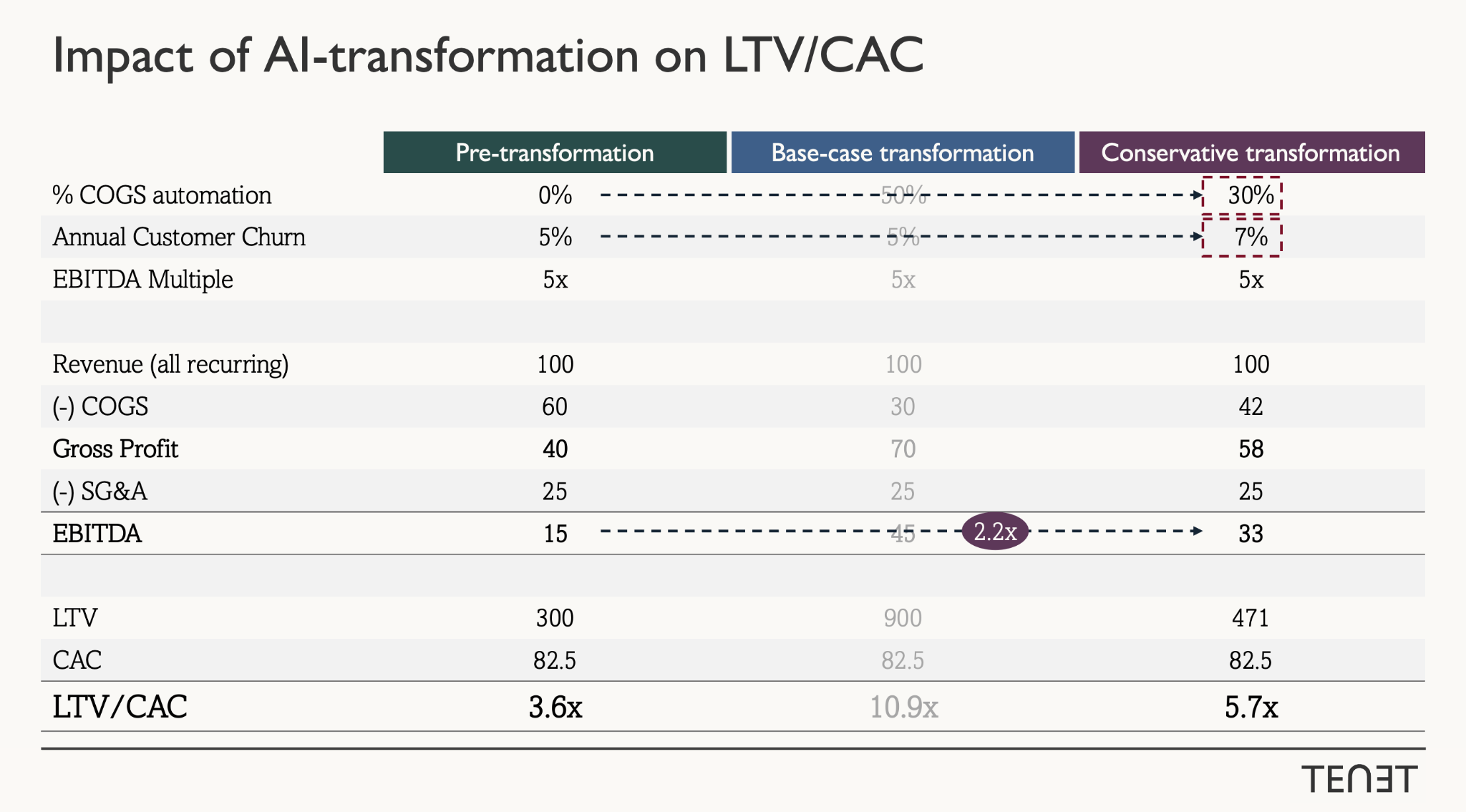
Even then, we end up with a >5.5x LTV/CAC. Still comfortably top-quartile in the world of traditional SaaS!
And even these assumptions remain very conservative.
- Many of the verticals targeted by AI Roll-ups exhibit relatively low recurring revenue churn. In the majority of cases, service quality and responsiveness improve after transformation, creating revenue expansion rather than contraction. Increased throughput capacity is often used to drive margin expansion via growth (more customers and products, without adding costs) rather than just via cost (same customers and products at lower cost base). Even if customer churn were to occur immediately following an acquisition, it would likely stabilize after the first one or two years. (For context, a 7% annual churn rate implies 40% of all revenue is churned away within 7 years!)
- So far we've only considered improvements to COGS. In practice, AI can also streamline SG&A functions such as billing, scheduling, reporting and internal operations, creating further operating leverage.
- Finally, while LTV/CAC should theoretically be independent of financing structure, AI Roll-ups are somewhat unique in that acquisitions are often funded with only 20-50% upfront equity, with the remainder financed through debt, seller notes and earn-outs. While not part of the LTV/CAC calculation itself, this further enhances the overall economics. Quantifying how leverage and deferred consideration reshape these returns is a meaningful exercise in itself (one we may return to in a future post!)
So we now know AI Roll-ups can deliver exceptional LTV/CAC characteristics, under conservative assumptions, and challenging definitions.
Next, let's flip the question on its head …
3. Working Backwards - "Goal Seek" for LTV/CAC 3x
As one final exercise, let's do the reverse calculation: what would lead to the LTV/CAC of AI Roll-up to drop to 3x?
There are infinitely many combinations, but here are some possible scenarios:
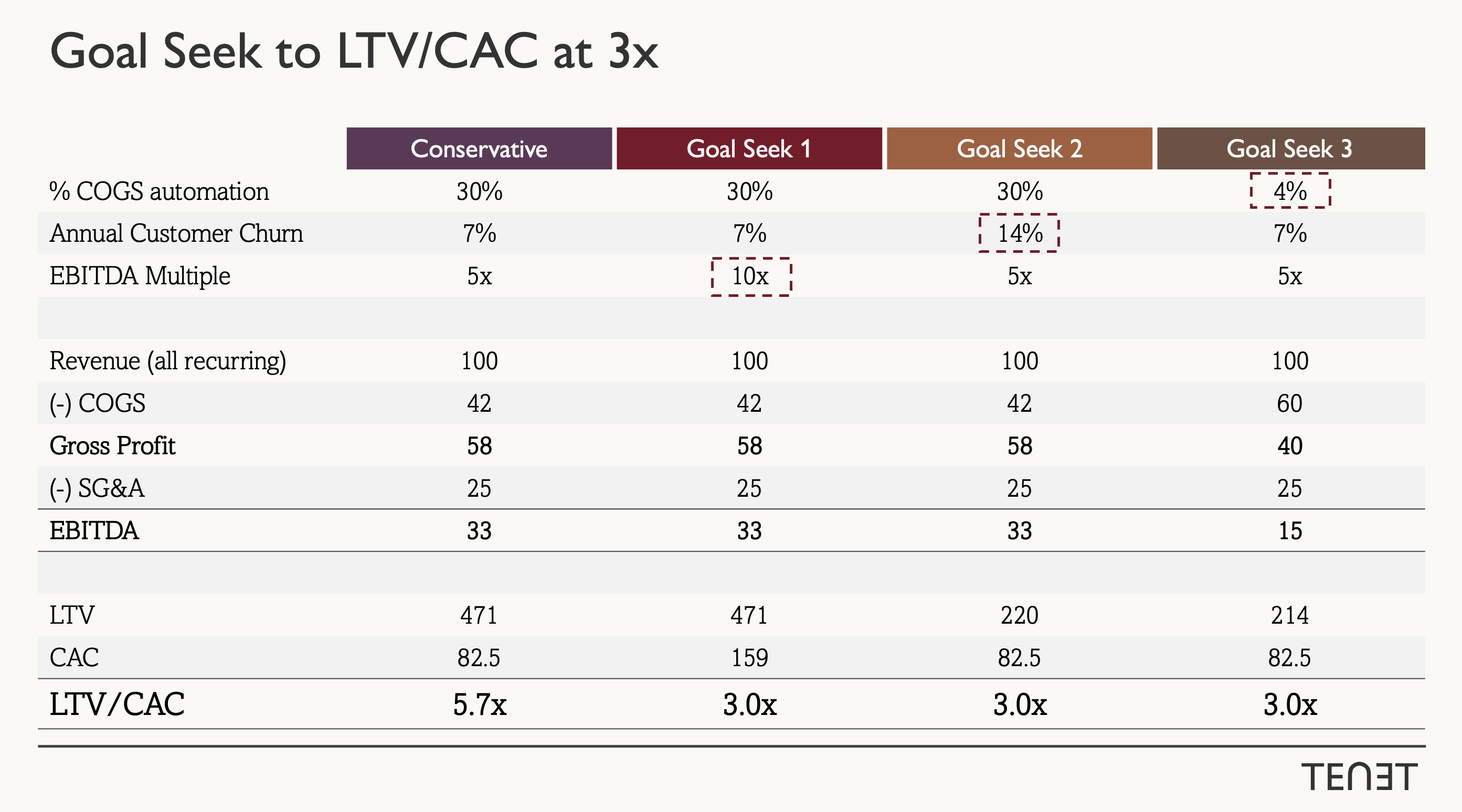
- Goal Seek 1: Acquisition discipline disappears and buyers consistently pay 10x EBITDA rather than 2–5x; OR
- Goal Seek 2: Annual churn explodes to 14% (this means total churn is 65% in 7 years); OR
- Goal Seek 3: AI transformation fails to deliver any meaningful productivity uplift, but churn still increases to 7% annually
These are all fairly extreme assumptions - but they drive the point home:
For SaaS, achieving a 3x LTV/CAC often requires being a positive outlier.
For AI Roll-ups, reaching the same ratio may require becoming a negative outlier.
Stepping back
We think LTV/CAC is a very interesting lens to compare business models. When viewed through this familiar framework, the economics of scaling an AI Roll-up appear remarkably compelling compared to a SaaS business. AI Roll-ups almost eliminate GTM and PMF risks, and shift the risk profile more towards careful selection of the terrain, and execution.
We have been SaaS investors for several years, and have had front-row seats to market transformations using technology. Our belief in the power of AI and Software continues with Tenet, but our strong conviction is that AI Roll-ups are a better delivery mechanism for the diffusion of this technology into European small businesses. Attractive LTV/CAC dynamics are just one of many reasons for this optimism!
If you're curious about our views on the AI Roll-up playbook, do give us a shout!