
About AI Roll-ups
AI-powered Roll-ups combine the traditional buy-and-build playbook with the leverage of modern AI. They acquire fragmented service businesses and apply AI to automate knowledge work, expand margins, and create software-like economics in industries that have historically run on human labour.
AI Roll-ups were the talk of the town in 2025
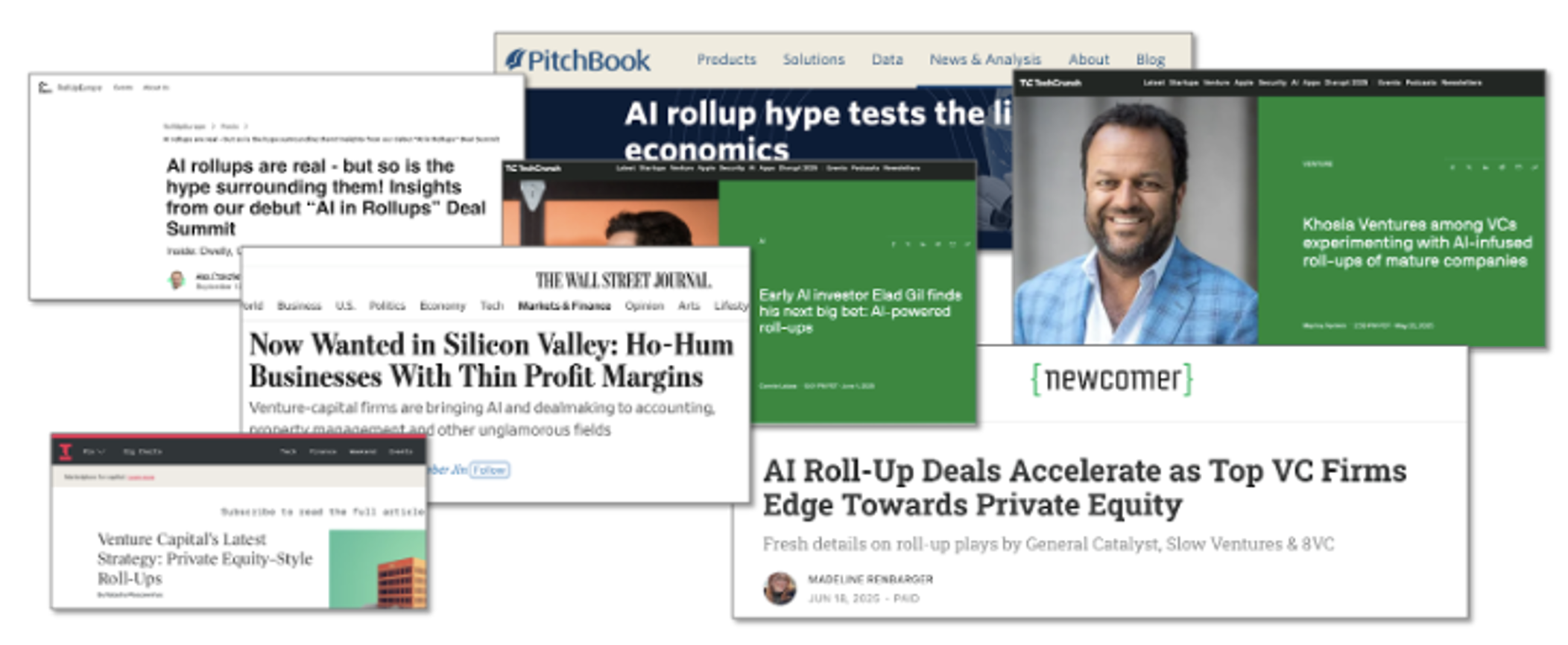
As covered by
Google Search Interest: "AI Roll-up" (2025)
Google Trends relative search volume (0–100)
AI Roll-up Nexus: Companies Tracked (2025)
Number of companies in the AI Roll-up Nexus database
From Hype to Hard Capital
Despite the noise, critical questions remain for founders and investors alike. Does the surge in interest translate to genuine investment appetite? Is there sufficient dry powder to support these companies across their entire lifecycle?
As an investment firm dedicated to this category, we conducted this survey to move past the anecdotes. Our goal is to provide a data-driven look at investor sentiment, return expectations, and the specific mandates of the capital providers now shaping this space.
Survey Design and Methodology
22
Questions
102
Responses (N)
Mixed
Format (MCQ, Free Text)
Mixed
Modality (In-person + Async)
No Material Changes to responses
Exceptions include:
- A. Clean-up: non-investor responses eliminated
- B. Classification: LLMs used to classify free-text responses
- C. Categorisation: certain responses (e.g. stage focus) clubbed together if individual categories did not have critical mass of responses
- D. Enrichment: certain fields (e.g. geographical focus) enriched based on Pitchbook data
About the Participants
A big thank you to the 100+ respondents who participated in the survey
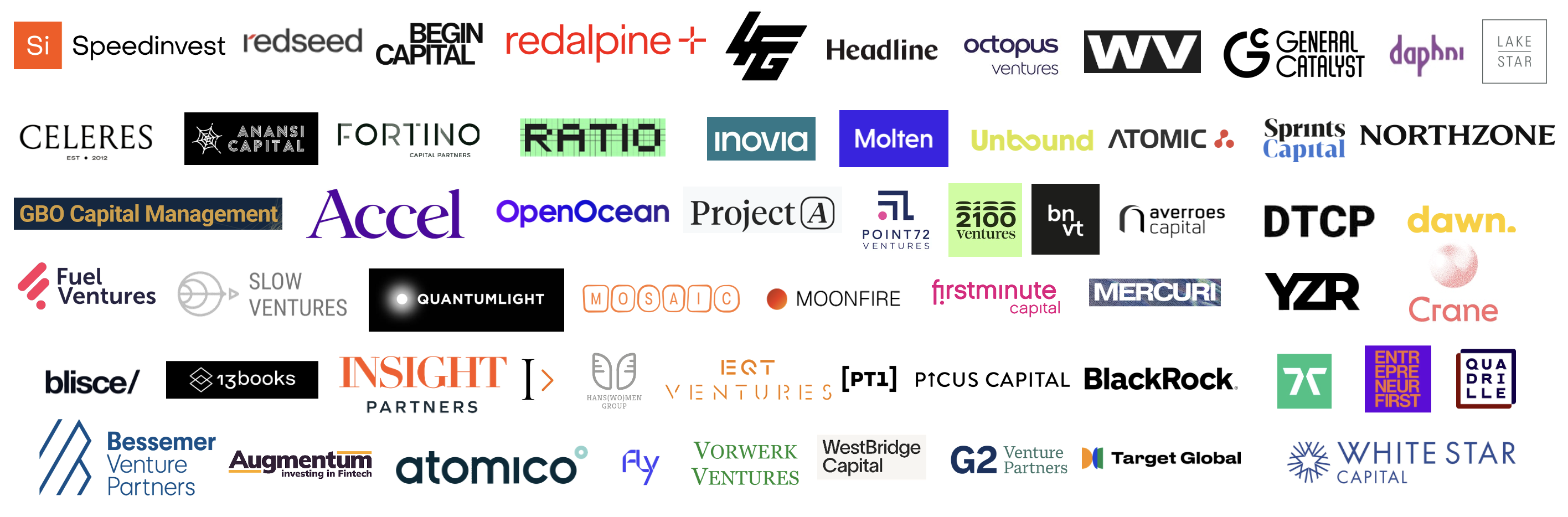
~80% VC & Growth Equity; balanced by Family Offices and PE
European funds account for roughly half of the responses
Good mix of stage-focus among VC respondents
Executive Summary
Dawn of a new asset class?
- At least half of the respondents believe AI Roll-ups are a new asset class in themselves; and ~15% believe they may deliver truly VC-scale returns
- >45% believe AI Roll-ups could be a larger VC opportunity than Crypto ($120b deployed); and >60% believe they could deliver better IRRs as compared to Public Equities (~10%) and even Private Equity (~15%)
- Regardless of categorisation, an overwhelming majority (>90%) of respondents expect them to receive moderate-to-significant investor interest in the next 12-18 months
AI Roll-ups are not an 'obscure' strategy anymore
- >90% respondents conveyed willingness to explore an AI Roll-up investment; and at least 40% respondents actively looking to invest in the category
Investment appetite rises sharply after 1–2 proof-of-concept acquisitions
- Leaving a gap in equity financing options for doing the initial acquisitions post product-build
- Investors interested, but more tentative about companies pivoting from Vertical SaaS/Agents to full-stack AI Roll-ups
Investors consider ideal founding teams to have AI application expertise, M&A skills, and Domain experience
- Change management ranks lower than expected among "must-have" founder capabilities
- Best signals for investors: prior experience in M&A (buy and/or sell side), domain, operations, change management
AI is the real-game in AI Roll-ups (obviously!)
- AI-led margin improvement widely considered biggest value-creation lever (86% responses); followed by traditional levers like Multiple Expansion (46% responses), and AI-led topline improvement (32% responses)
- A 2x EBITDA improvement in acquired assets would cross the bar for 90% investors
Investors largely aligned on what they consider the biggest risks in this space
- Integration & Change Management (79% responses), and Overhyped AI value-creation (68% responses) considered the biggest risks
- Poor M&A discipline ranks #3 on the list of risks (probably a hangover from the FBA aggregator era?)
Some "Hot Sectors" emerging
- Professional Services and Financial Services emerging as favourite spaces for investors
- IT Services, Trade & Logistics, Real Estate seem underpenetrated compared to investor interest
Exit paths unclear, but consistent hypotheses forming
- ~80% believe M&A by PE Consolidators is the primary exit route
- Interestingly, 30%+ also consider IPO as a valid route (for breakout 'VC-scale' cases)
Perceptions
Roughly half of the participants feel AI Roll-ups are a new category in itself; remaining opinions also bucket them into VC or PE categories.
At Tenet, we believe AI Roll-ups present a "PE Floor with a VC Ceiling"
Given the scope for margin transformation using AI, we believe AI Roll-ups have the potential to deliver returns that go beyond the traditional PE value-creation toolkit of leverage, multiple expansion, and SG&A synergies. In certain sectors, high levels of automation and breakout growth could push these into truly VC-scale territory.
Whether a particular AI Roll-up ends up scaling more VC-style or PE-style depends on AI capabilities 2–3 years down the line, and also how quickly the market adopts and reprices services based on these AI efficiencies. They have the potential to, but might not always end up exhibiting the outlier returns that are necessary for VC fund-returner maths.
AI Roll-ups also exhibit a distinct risk profile compared to both VC and PE. Even at inception, they minimise GTM risk because you buy your distribution, and PMF risk because you're delivering the same service as before (just with a lower, AI-enabled cost structure) compared to VC-funded SaaS. That said, the depth of operational transformation involved introduces a different kind of execution complexity.
Overall, AI Roll-ups should be treated as a different category, at least at inception. They might exhibit VC-like or PE-like scaling after the first few acquisitions, once the playbook and tech-stack starts reaching maturity.
PE investors disproportionately consider AI Roll-ups a new category
Broadly similar perceptions globally towards categorization of AI Roll-ups
% who believe AI Roll-ups are a bigger opportunity vs:
% who believe AI Roll-ups will deliver better IRR vs:
It's not a surprise that > 90% of participants believe AI Roll-ups will receive significant investor attention in the coming 12–18 months.
The moment we said we want to acquire and roll-up, VCs would roll their eyes, and effectively don't want to engage in conversation further; and start fingerpointing you towards PE guys. When you come to PE guys they say 'great, roll-up, even originations from scratch — we're happy to do that. But tech transformation is not something we're happy to engage in — go talk to VCs'. So eventually in the very beginning, we were falling somewhere between the cracks.
Dan Lifshits
Founder, Dwelly
Source: Webinar – AI Roll-ups VC with a Twist or PE with a Prompt?
Investment Appetite
At least 40% of respondents actively looking to invest; highest interest from Pre-seed/Seed VCs and Family Offices
European sentiment in-line with global firms; USA firms more favourable
This is understandable, given Europe has the "perfect storm" of ageing population with acute labour shortages, big succession crisis with baby boomer SMB owners retiring, and lowest rates of vertical software penetration in SMBs.
Highest investment appetite once initial product build and proof-of-concept acquisitions completed
After 1–2 acquisitions, the playbook is substantially proven, unlocking diverse sources of capital across VC & PE, and a clearer ability to price the upside. It is no surprise then, that the majority of investors are looking to participate at that stage.
There is also notable interest at inception-stage, primarily from Pre-seed/Seed funds. However, we question whether a typical $1–3m seed cheque would be sufficient to fund the first few acquisitions, and also make the necessary investments in product/technology and change management initiatives to drive successful transformations.
Further, appetite seems to substantially reduce at the pre-acquisition stage when a company has a product but no acquisitions that can prove the transformation potential.
At Tenet, we believe the inception and pre-acquisition stages should be combined into a slightly larger inception-round. This provides founders with sufficient firepower to finance both initial product build and first 1–2 acquisitions with transformation proof points; putting them in a much better position to raise additional capital to scale.
Investors open, but much more tentative about Vertical SaaS / Agentic companies pivoting to AI Roll-ups
Pivot path pre-conditions:
- A. Supportive and thesis-aligned investors on the cap-table
- B. Proof of potential EBITDA uplift
Hard transformations required:
- A. Reduce burn, create a lean HQ
- B. Recalibrate valuations (from Revenue multiple to EBITDA multiple)
- C. Review the team — are they ready for M&A, change management, service operations?
- D. Plan out the "product-mindset to service-mindset" shift
- E. Master communications to existing customers of your "product"
Metropolis, Buena, and several other case studies now suggest that the Pivot Path is possible.
We cover this path here.
We didn't find product market fit. We burned through $14m over a few years. We had enough money for one pivot. Things had to move fast. We realized that M&A could be our initial go-to-market strategy. We acquired a few property management businesses & showed amazing profit uplifts quickly. I was hyped. This should allow us to raise a proper round.
Din Bisevac
Founder, Buena
Source: Twitter post by Din
Founding Teams
What is the magic combination of "must-have" qualities in a founding team?
More than half of investors believe AI expertise, Domain experience, and M&A skills are must-haves
This is a hotly debatable topic (with seemingly no right answer). We agree with AI application understanding as a must-have founder skill. But here's where we diverge from the consensus:
- • M&A and Fundraising are learnable / augmentable skills to a decent degree — not "must have"
- • Domain understanding could also be gained through pilots / design partners or just outside-in exposure — not "must have"
- • Change management is highly under-rated as a "must-have founder skill". AI Roll-ups will need to be driven by highly empathetic leaders who could transform businesses without breaking them
Ultimately, successful AI Roll-up founders won't all look the same.
Variance in "must-have" qualities across investor types, stages, and geographies
By Investor Type (%)
| Skill | Family Office | PE fund | VC fund |
|---|---|---|---|
| Domain Experience | 29% | 54% | 60% |
| M&A skills | 71% | 77% | 55% |
| Building AI Applications | 43% | 54% | 58% |
| Change Management | 71% | 46% | 47% |
| Fundraising (Debt & Equity) | 71% | 8% | 39% |
By Investor Stage (%)
| Skill | Pre-seed / Seed | Seed / Series A | Series A-B | Series B+ | Multi-stage |
|---|---|---|---|---|---|
| Domain Experience | 32% | 76% | 63% | 67% | 74% |
| M&A skills | 64% | 41% | 63% | 58% | 53% |
| Building AI Applications | 60% | 53% | 50% | 42% | 74% |
| Change Management | 52% | 59% | 38% | 42% | 42% |
| Fundraising (Debt & Equity) | 56% | 35% | 50% | 17% | 32% |
By Geography (%)
| Skill | Global | USA | Europe |
|---|---|---|---|
| Domain Experience | 61% | 53% | 53% |
| M&A skills | 64% | 65% | 59% |
| Building AI Applications | 46% | 65% | 65% |
| Change Management | 61% | 35% | 47% |
| Fundraising (Debt & Equity) | 32% | 35% | 39% |
What signals can founders give investors? Qualitative responses confirm the trend
Note: free-text responses categorized using LLMs
Value Creation
AI-led bottomline improvement expected to be the largest value creation driver; followed by classic PE levers
While AI-led margin transformation is viewed as the primary value-creation lever, AI-led topline growth remains underappreciated. Our favourite industries are ones where you can substantially grow both topline & margin % through AI — thus getting a dual-benefit. This also allows companies to repurpose newly unlocked team capacity towards new business, rather than doing layoffs to realise the benefit of AI-led efficiencies.
We are also very excited for the potential for AI-native businesses to add new products (with potentially software-like Gross Margins). Think analytics for Accounting clients, cybersecurity/compliance for IT MSP customers, searchable database of interviews for expert networks.
How much EBITDA uplift is "good enough"?
> 90% of respondents would consider 2× EBITDA (100%+ uplift) a sufficient bar for viable AI Roll-ups
EBITDA uplifts through traditional PE Roll-up levers (HQ consolidation, centralized SG&A) typically cap out at 10–15%. By that comparison 25%, 50%, 100%, and 200%+ EBITDA uplift are all superior outcomes — but the bar is set by (a) the cost to achieve this uplift, and (b) future financing strategies for scaling.
For instance:
- A. 25% (1.25x) uplift might not be enough to justify heavy product/technology investments at the HQ level.
- B. A 100% (2x) EBITDA uplift might be able to absorb significant HQ costs, but still might not be sufficient to achieve 50x+ returns for equity investors to fall within the VC Power Law. And hence might find it more appropriate to scale with more PE-style capital structures.
- C. Our internal simulation suggests that a 200% (3x) EBITDA uplift may represent the threshold for a VC-funded AI Roll-up.
At Tenet, we believe both scenarios (b) and (c) make a strong investment case, and must be pursued. However, instead of force-fitting a particular capital structure on the company early on, we lean on maintaining the flexibility to choose downstream financing which is best aligned with the scaling profile of the business.
People are justifiably excited about the potential to improve operational efficiency using AI in traditional services businesses. But for us at Arbio, the more exciting lever has been improving rental yields of owners' properties by leveraging AI to improve pricing, and to raise the bar for customer service.
Constantin Schröder
Founder, Arbio
Exciting Sectors
Sectors preferred by Investors vs Sectors in AI Roll-up Nexus
Comparing the Survey and Nexus data, "Real Estate Services (USA)", "Trade & Logistics (Europe)", and "IT Services (Globally)" are the largest untapped opportunity areas.
You can also check out our public Industry Screener to explore more sectors.
Risks and Lessons
More than half of respondents concerned about Integration/Change Management, Overhyped AI value-creation, and poor M&A discipline
- • Change Management complexity is certainly our #1 consideration (golden rule: it is more complex than one thinks it is!)
- • We are sold on AI value creation potential in several industries; but are more concerned around doing too much too quickly, or fully automating things which need humans-in-the-loop. This points to lack of "Systems Thinking" more than AI hype.
- • Concerns around disintermediation & defensibility feel valid, but can be mitigated to a good degree through careful industry selection. (We have a framework for when not to roll up!)
- • Poor M&A discipline ranking so high was surprising (maybe fallout from the "FBA aggregator" era?)
Lessons from the field
This is largely an investor-sentiment report, but we thought it would be remiss of us to not include some hard-won lessons from the trenches through founder conversations!
You can read about them here.
When you're small, every acquisition matters disproportionately, which means you can afford to integrate with a level of intensity and precision that large platforms simply can't. Larger platforms try to integrate from a distance. Through playbooks, templates, and layers of middle management. The nuance gets lost, and nuance is everything in services businesses. By contrast, all of our acquisitions sit in our offices within 30–45 days. They're part of the culture from week 2. We have changed brands within 2 weeks. And second point is speed: We're integrating systems, support people, offices — everything — within 60 days of acquisition.
David Alonso Martinez
Founder, Zinco AI
Source: Panel discussion at RollUpEurope
Exit Paths
80% of respondents believe PE consolidators are the most likely exit path; one-third believe IPO is also a feasible option
The market for exits is a big unknown right now — but we could predict some outcomes.
- • PE consolidators should remain a key buyer of AI Roll-ups, especially ones which breach the lower mid-market size ($15m in EBITDA). But will they continue to pay premium multiples for scale?
- • IPO is a realistic exit path for companies that exhibit breakout scale and growth. We already have examples like Brown & Brown (Insurance Broker), Foxtons (Property Managers/Lettings), Kühne+Nagel (Logistics) [and of course listed accounting firms]. So what would it take for something to IPO?
A combination of PE/HoldCo acquisitions, and IPO reinforces the "PE Floor with a VC Ceiling" viewpoint.
More (Unfiltered) Soundbites
We asked investors for their unvarnished takes; the range reflects the genuine debate in the market. 🌶️ marks the spicier takes.
“It is not a simple search fund / PE case. It is at the intersection of PE and VC and can bring great returns for both.”
“That elite scaling and operational experience is more important than domain.”
“Minority model won't hit return curve unless you're owning 30%+”
“I think AI roll-ups may still deliver returns, but not the kind VCs are underwriting.”🌶️
“Starting with AI and acquiring customers through acquisitions likely tells me that you are not a very strong founder — just a strong CTO at best.”
“There are too many investors following this space, which will ultimately drive acquisition pricing and therefore compress returns.”
“Most operators read 'buy and build' and think they have what it takes — out of 100 operators I spoke with, maybe 3 are really capable of executing.”🌶️
“Here to stay and potential to change services landscape as we know it.”
“Most current AI roll-up team don't have sufficient AI implementation experience nor have true roll-up experience.”
“There are a ton of legacy markets which have not changed in 20+ years where this strategy makes sense.”
“Many will do it and few will execute it well. It's the 'Rocket Internet' model of the GenAI era.”🌶️
“We're 5 years too early for it to be generational. Plenty will get burnt in the short term.”
“Only an AI rollup if you can take a low %age EBITDA business and truly transform it into a 50%+ EBITDA business. Must be real transformational change, rather than just cost optimisation.”
“You can actually make good returns on the rollups without firing people post M&A.”
Disclaimer
This report (the "Report") has been prepared and published by Tenet (the "Fund"), a fund incorporated in Germany, and is made available for general informational and branding purposes only. This Report is intended solely to provide aggregated insights into investor sentiment regarding AI roll-up strategies and related themes. It does not constitute investment advice, financial promotion, or an offer to sell or a solicitation of an offer to buy any securities, fund interests, or other financial instruments in Germany, the United Kingdom, or any other jurisdiction.
The Report is based on an independent survey conducted by the Fund among approximately one hundred investors. All responses have been anonymised, aggregated, and categorised. No statements, data points, or views are attributed to any specific investor, investment firm, or individual unless expressly stated. The inclusion of survey findings reflects the opinions of participants at the time the survey was conducted and may not reflect current market conditions or future developments.
Certain third-party names, trademarks, and logos may appear in this Report for identification purposes only. All trademarks, logos, and brand names are the property of their respective owners. Their inclusion does not imply any endorsement, sponsorship, approval, affiliation, or association with the Fund or this Report. The Fund has not attributed any survey responses to any specific firm, and no firm has endorsed the findings of this Report unless explicitly stated.
Founder quotations included in this Report are sourced from publicly available materials, including panel discussions and social media posts, as cited. Quotations may have been edited for clarity, brevity, or formatting, without altering their substantive meaning. The views expressed are those of the individuals quoted and do not represent the views of the Fund.
Nothing in this Report constitutes or should be construed as investment advice within the meaning of applicable German or UK financial regulatory laws, including but not limited to the German Securities Trading Act (Wertpapierhandelsgesetz) or the UK Financial Services and Markets Act 2000. This Report does not constitute a prospectus, offering memorandum, private placement memorandum, or any form of regulated financial promotion. It is not intended to form the basis of any investment decision. Any investment in a vehicle managed by the Fund will be made solely on the basis of formal legal documentation and in compliance with applicable laws and regulations.
The information contained in this Report has been prepared in good faith. However, the Fund makes no representation or warranty, express or implied, as to the accuracy, completeness, adequacy, or reliability of the information, data, or opinions contained herein. Survey-based findings are inherently subject to limitations, including sample size, respondent bias, and interpretation.
This Report may contain forward-looking statements, including statements regarding market trends, industry developments, expectations, and potential future outcomes. Such statements are inherently subject to risks, uncertainties, and assumptions, and actual results may differ materially from those expressed or implied. The Fund undertakes no obligation to update, revise, or amend any forward-looking statements or other information contained in this Report.
To the fullest extent permitted by applicable law, the Fund disclaims all liability for any direct, indirect, incidental, consequential, or other loss or damage arising from any use of or reliance on this Report or its contents. Readers are encouraged to seek independent legal, financial, tax, and other professional advice before making any investment or business decisions.
The Fund assumes no obligation to update, revise, or supplement this Report following publication. This Report is confidential and proprietary to the Fund. No part of this Report may be reproduced, distributed, transmitted, or published without the prior written consent of the Fund.
© 2026 Tenet. All rights reserved.