Summary
AI-powered roll-ups combine the acquisition strategy traditionally used by Private Equity with the operational leverage of AI and software. Instead of selling software to service providers, the company acquires existing businesses and applies proprietary AI systems to automate and improve the service itself. This approach allows founders to “buy distribution” through acquisitions while using automation to significantly expand margins.
The opportunity exists because many service industries remain highly manual and fragmented. In these sectors, selling software alone can be difficult due to resistance to change. By owning the service provider and embedding AI directly into operations, companies can capture more of the value created by automation. If implemented successfully, AI roll-ups could generate dramatic improvements in EBITDA (sometimes 2–3×) while benefiting from both PE-style cash flows and venture-scale growth potential.
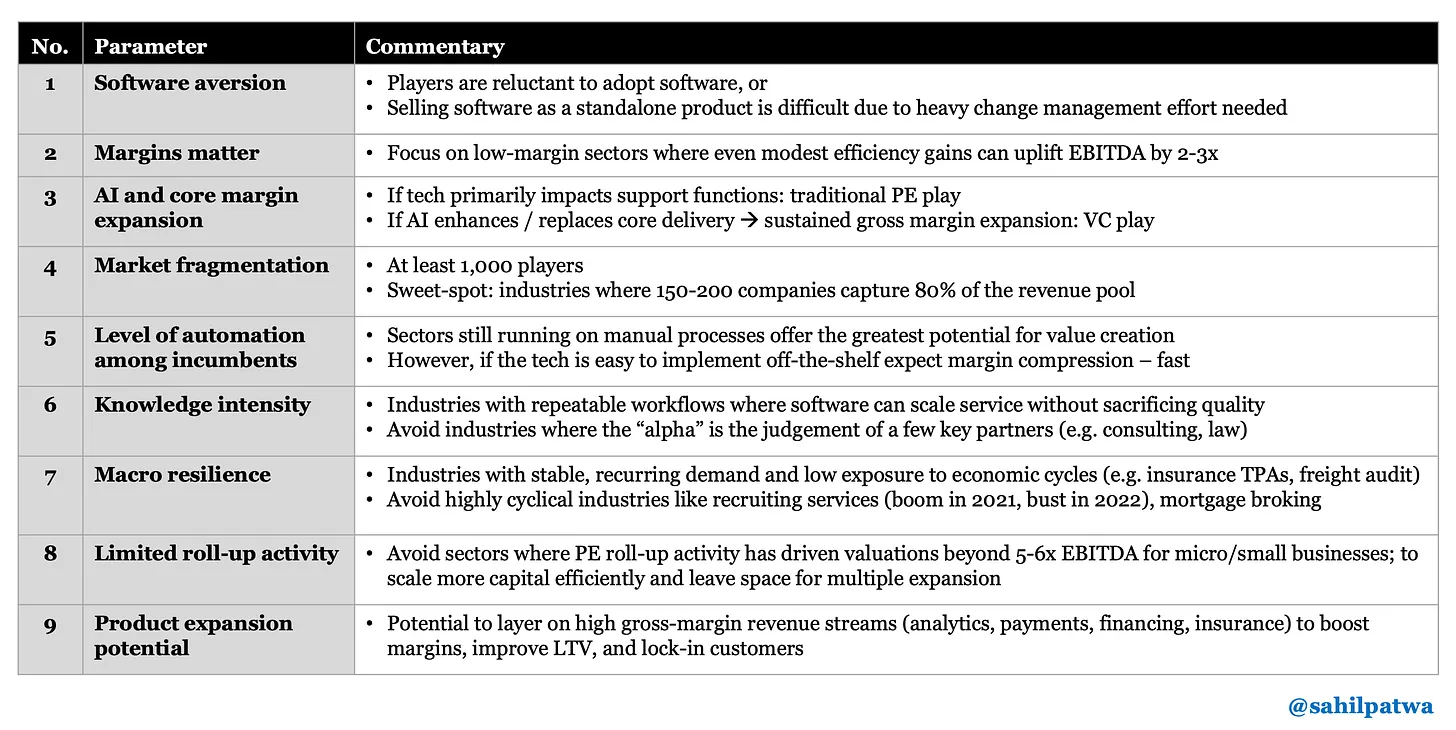
However, not every industry is suitable for this strategy. Several characteristics make a sector particularly attractive for AI-driven consolidation.
Check out our Industry Screener to see the framework in action
Characteristics of Attractive Industries for AI Roll-Ups
First, industries with low software adoption are strong candidates, since operational transformation may be easier when technology is introduced through ownership rather than software sales.
Second, low-margin but high-revenue sectors can benefit disproportionately from efficiency improvements. Even modest operational gains can dramatically expand EBITDA.
Third, the most compelling opportunities are those where AI can automate the core service itself, not just administrative or back-office tasks. When automation directly improves the core workflow, the result can be true gross margin expansion rather than incremental efficiency gains.
Market structure also plays a critical role. Highly fragmented industries with hundreds or thousands of operators provide a large pool of acquisition targets and make consolidation strategies more feasible.
Sectors that still rely heavily on manual workflows offer the greatest opportunity for step-change improvements through automation. Conversely, industries that rely on specialized expertise—such as high-end consulting or legal services—may be harder to automate and therefore less suitable for AI-driven roll-ups.
Additional Factors That Strengthen the Strategy
Several additional factors can increase the attractiveness of a roll-up opportunity. Industries with stable demand and recurring revenue provide more predictable cash flows and reduce exposure to economic cycles.
Sectors with limited existing roll-up competition may also present better acquisition opportunities, since valuations are less likely to be inflated by private equity activity.
Finally, opportunities to layer on adjacent products (such as payments, financing, or insurance) can further increase margins and strengthen customer relationships. Over time, this can transform a services business into a full-stack platform.
When these characteristics align, AI-powered roll-ups may offer a compelling model: A PE-floor with a VC-ceiling.