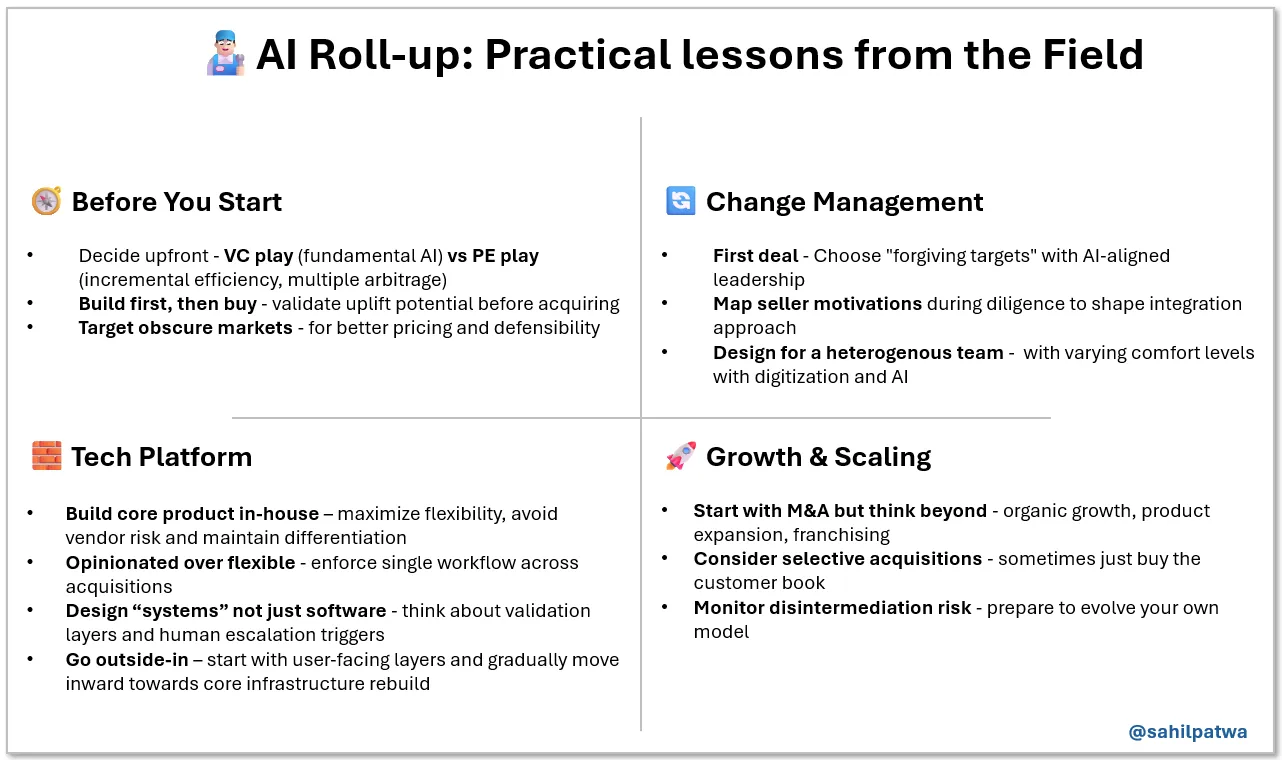
Implementing AI-powered roll-ups is far from theoretical—real-world experience highlights key lessons for founders. Successful roll-ups begin with clear upfront choices: define whether the strategy is VC-style, focused on fundamental AI transformation, or PE-style, relying on efficiency gains and multiple expansion. Founders should build technology platforms first, validating the ability to drive meaningful EBITDA improvement before pursuing acquisitions.
Choosing obscure markets can provide defensible margins and better pricing for acquisitions. Change management is critical: integration success depends on understanding seller motivations, designing training for heterogeneous teams, and selecting forgiving first acquisition targets to refine playbooks.
A scalable tech platform requires in-house core products, outside-in platform rebuilds, and opinionated software that enforces consistent processes across acquisitions. Systems-level thinking—not just automation—ensures quality, manages risk, and supports human-AI collaboration.
Growth extends beyond M&A. Organic growth arises from superior AI-native service delivery, technology product expansion, and even franchising of the platform. Selective acquisition strategies—acquiring just customer relationships or business units—can accelerate scale while minimizing complexity. Founders must also anticipate disintermediation risks, as technology may enable customers to bypass the service layer.
These field lessons reinforce that AI roll-ups require deliberate strategy, operational discipline, and a continuously evolving tech platform. Executed well, they create powerful growth engines, blending technology, people, and processes to scale AI-enabled services efficiently.