AI Roll-up Nexus

A public resource for companies building and scaling through AI-powered Roll-up strategies

Back to Essays
Guide · 5 chaptersOctober 2026 · 27 min read

The Founder's Field Guide to Acquisitions

A primer on small/micro business M&A in the UK and Europe

Acquisitions are an essential part of the AI Roll-up playbook. Yet, across more than 100 AI Roll-up teams we've met, we've seen a recurring pattern: many of the strongest founders come from technology, operations, or the industry itself rather than from deal teams, so their first acquisition is often also their first deal. Even those with M&A experience tend to be surprised by how different the small end of the market is: below €2m EBITDA, sellers decide with their hearts as much as their spreadsheets, the best deals rarely reach a formal auction, the accounts are seldom as clean as they look, and a spouse or sibling you've never met can kill a deal in the final week. We wrote this Field Guide with these founders in mind.

It won’t turn you into an M&A expert, and it isn’t a substitute for an experienced deal team. Think of it as a map of the most common pitfalls. It should help you coordinate your experts (e.g. M&A advisers and due diligence consultants), pressure-test the processes, assumptions and motivations of everyone involved, and represent yourself well in front of sellers. That matters because in your first few acquisitions, the seller is judging you as much as your offer. We've kept this guide deliberately crisp, with five chapters that take you from sourcing to signing, with worked examples, practical considerations specific to AI Roll-ups, and a short quiz to test yourself. While we've over-indexed on Europe, the broader principles hold for other geographies too, even if the legal and tax details don't always travel.

This isn’t meant to be a theory textbook. We have tried to infuse this guide with practical, real-world nuance from people who do this for a living. Our co-author, Alex Maly (General Partner at Tenet), has spent the last seven years advising multiple platforms on more than 90 acquisitions. Other contributors include founders and M&A heads of successful European AI Roll-ups, as well as practitioners deep in the European micro-PE and buy-and-build ecosystem. Alongside their input, we have drawn on lessons from the many acquisitions we have seen up close. We are grateful to all of them for sharing unfiltered learnings from the field. Our goal is simple: that this guide helps more founders approach their first acquisitions with confidence, avoid expensive mistakes and build businesses that owners are proud to sell to.

Chapters 1–2 are out now. The remaining chapters will be released over the coming weeks.

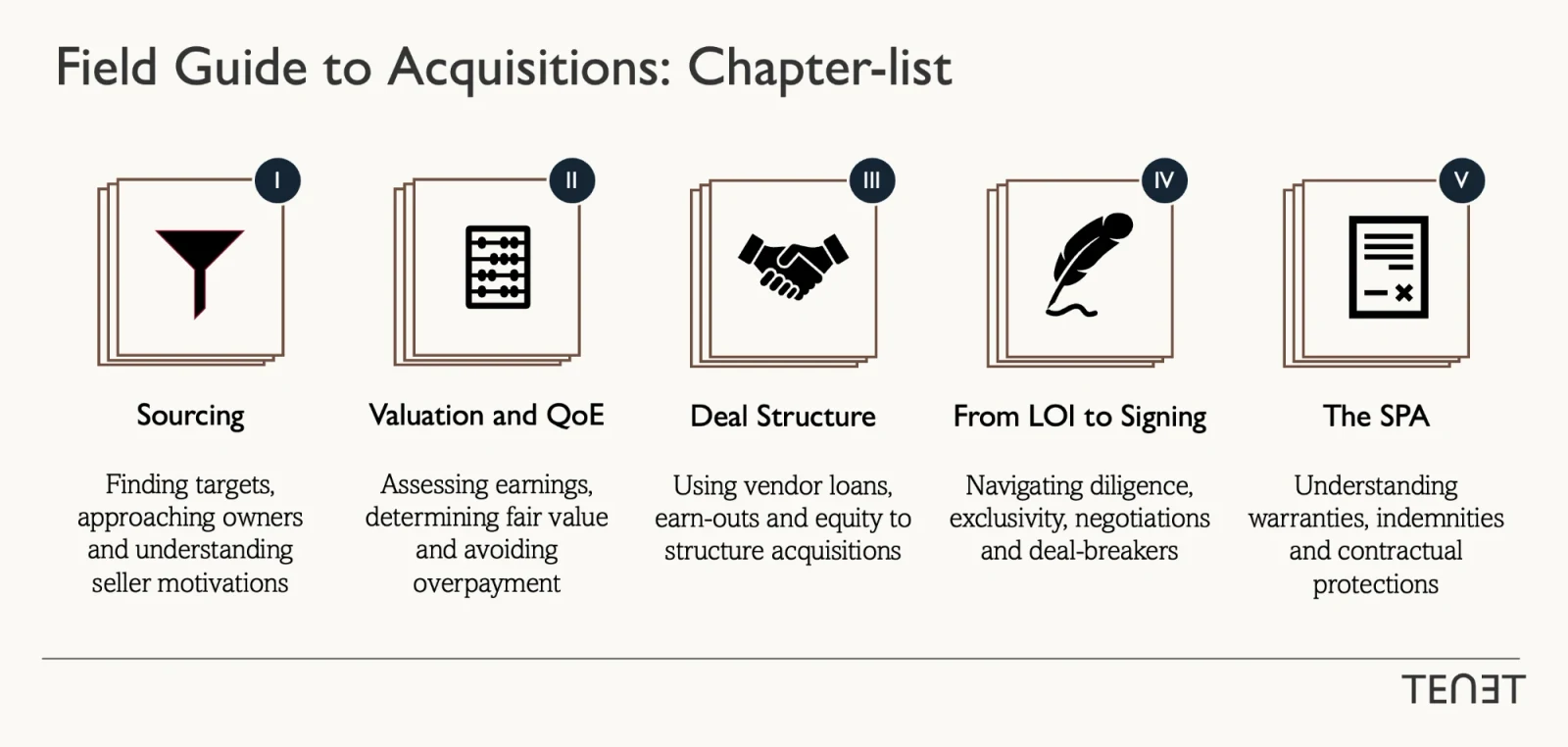
Field Guide to Acquisitions, chapter list. I, Sourcing: finding targets, approaching owners and understanding seller motivations. II, Valuation and QoE: assessing earnings, determining fair value and avoiding overpayment. III, Deal Structure: using vendor loans, earn-outs and equity to structure acquisitions. IV, From LOI to Signing: navigating diligence, exclusivity, negotiations and deal-breakers. V, The SPA: understanding warranties, indemnities and contractual protections. (opens the image full size in a new tab)
Tap to enlarge
Part 1 of 513 min read

Chapter 1: Sourcing

Sourcing is the first part of the acquisition funnel to get right. A strong sourcing engine gives you access to better businesses, reduces competition for deals and helps you build relationships with owners long before they are ready to sell. But sourcing at the smaller end of the market is rarely straightforward. Many attractive businesses are never formally put up for sale, financial information is often limited, and owners may take years to decide whether to sell.

This chapter covers how acquirers of UK and continental European businesses below €2m EBITDA find sellers, win their trust and manage a pipeline. The timelines and conversion rates quoted are practitioner rules of thumb that vary widely by sector and country, so treat them as approximate.

1. The seller universe

In Europe, a significant share of sellers at this size are founder-owners approaching retirement with no family successor. In Germany alone, ~300,000 retiring SMB owners lack any succession plan and face liquidation1. The same generational shift is playing out across Europe, with many of these businesses too small to attract traditional private equity. This creates a significant opportunity for micro buy-and-build platforms.

But retirement is only one reason owners sell. Understanding a seller's motivations is critical, as they shape everything from deal timelines and price expectations to the risks a buyer inherits.

Why owners sell, and what each reason means for the deal:

TriggerTypical seller behaviourWatch out for
Retirement, no successorPatient; cares about legacy; open to a 1–2 year handoverOwner may have stopped investing in the business years ago
Burnout or fatigueMotivated, wants a fast exitRecent under-investment; weak second layer of management
Death or ill healthEstate or family sells, often with urgencyLittle or no owner handover; knowledge leaves with the owner
Partner disagreement or divorcePrice tension between shareholdersPartners with different ages and goals can block or delay
DistressNeeds to sell, sometimes framed as retirementDeclining revenue or lost clients hidden behind the story
Rising regulatory or IT burdenCan't afford the investment the business now needsCompliance gaps you inherit

Seller types also matter:

  • Sole founder-operator: One decision-maker, but the business often depends heavily on them.
  • Multi-partner firms: Common in accountancy and insurance brokerage (though less common in <€2m EBITDA businesses). Every partner must agree, and partners of different ages want different things.
  • Second-generation family businesses: Family shareholders outside the business may have a say, and family politics can stall deals.
  • A business with a strong second-in-command: That person may want to buy it themselves, making them a rival bidder. Or they may be your future managing director, which could be an interesting opportunity.

Field lesson: find out early who actually owns the shares, who will make the final call, and how the owner expects the sale to run: their timeline, whether they plan to bring in an adviser, and whether they're talking to other buyers. Ask about the process rather than about authority. "Who else would you want involved in this decision?" feels more natural than "Who decides?" Then check the shareholder register yourself, because the answer you get in a first meeting isn't always the full picture.

2. Sourcing channels

How you source a deal can have a significant impact on what you pay for it. At this size, competition between buyers is often a major driver of price. A business marketed through a broker may attract several bidders, while one approached directly may have only you at the table.

Good acquirers run several sourcing channels in parallel, each with different trade-offs. Brokers provide access to sellers who are ready to transact, with more structured and often faster processes. Direct outreach and referrals can offer less competition, more attractive entry prices and greater control over the process, but typically require more time and effort to convert into deals.

2.1 Brokers and sell-side boutiques

At this size, sell-side advisers are local business brokers, small M&A boutiques, and the corporate finance teams of regional accounting firms. Quality varies widely.
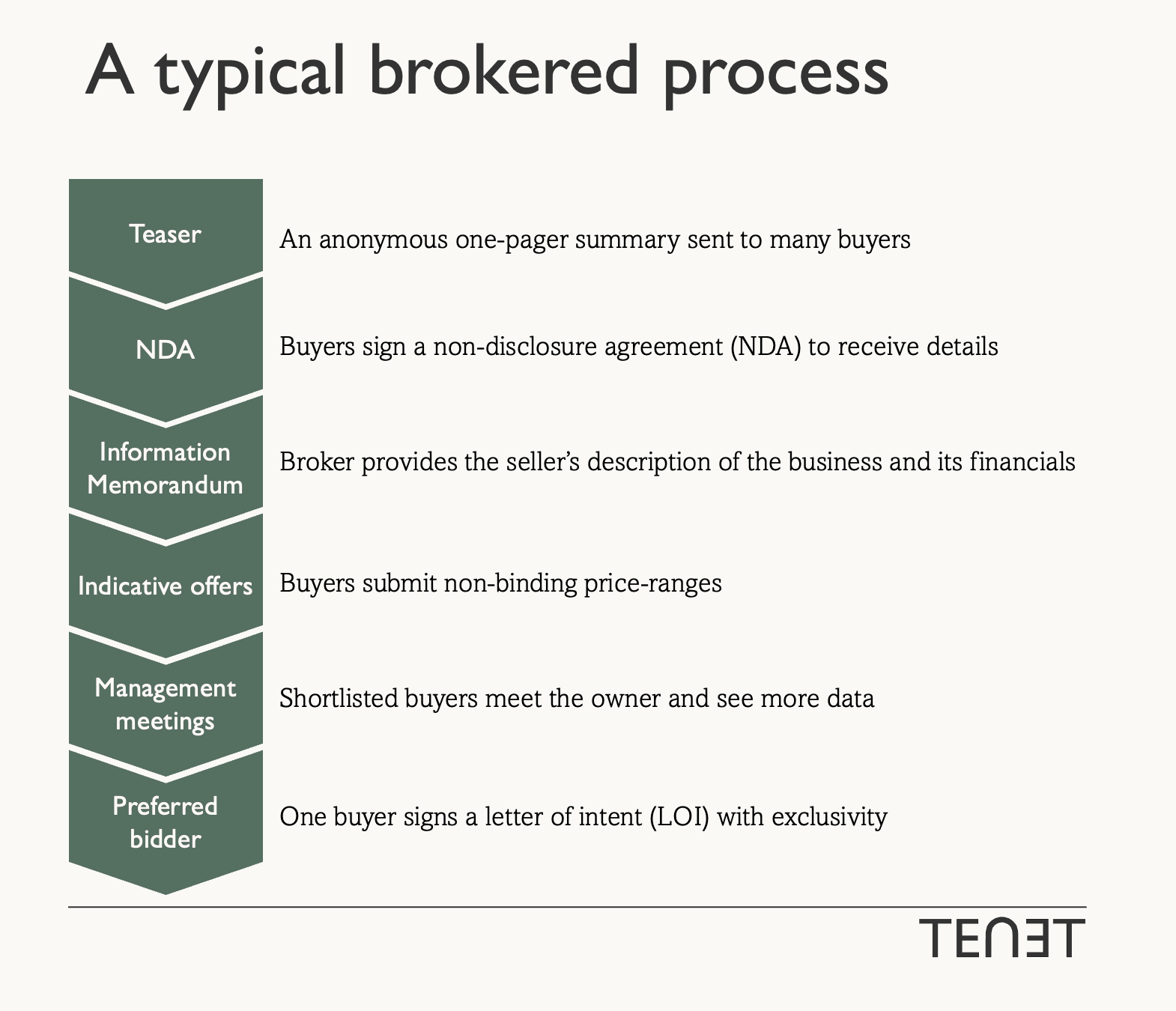
A typical brokered process, in six steps: Teaser, an anonymous one-pager summary sent to many buyers; NDA, buyers sign a non-disclosure agreement to receive details; Information Memorandum, the broker provides the seller’s description of the business and its financials; Indicative offers, buyers submit non-binding price ranges; Management meetings, shortlisted buyers meet the owner and see more data; Preferred bidder, one buyer signs a letter of intent (LOI) with exclusivity. (opens the image full size in a new tab)
Tap to enlarge

How brokers are paid:

  • Mostly a success fee from the seller, typically a few percent of deal value, often with a minimum.
  • Some brokers charge substantial upfront fees rather than relying primarily on success fees. Understand their incentives, as these arrangements may provide less motivation to complete a transaction.

What this means for you:

  • Upside: the seller has decided to sell, the information is packaged, and it moves faster.
  • Downside: you face competition, and the broker is paid on price and completion, not on fit. The IM presents the business in its best light, with “adjusted EBITDA” as the most favourable version of the numbers, so much of what matters won’t be in it. You need to know which questions to ask to find it.

Field lesson: Good brokers remember which buyers close reliably and don't cut the price late. They call those buyers first next time. Being a known, reliable buyer is itself a sourcing channel.

2.2 Direct (proprietary) outreach

You build a target list from company registries and commercial databases, then contact owners by letter, email, phone, LinkedIn, or in-person.

  • Registries differ by country. UK Companies House is free and searchable, but smaller companies disclose limited financial information. German filings are similarly limited, while Nordic registries, particularly in Sweden and Norway, offer much greater transparency. Buyers often need to combine registry data with headcount, sector and other commercial information to identify suitable targets.
  • Regulated sectors come with ready-made target lists. Public registers list every authorised firm, such as the FCA register for UK insurance brokers, and professional bodies publish directories of their members, such as accountants and tax advisers. Combine them with company registry data to filter by size.
  • Conversion is low and slow. Most owners say "not now". The value comes from systematic follow-up over months or years, so CRM discipline is the real capability.
  • Message quality matters. Outreach that is local-language, specific to the owner's business and focused on their concerns converts far better than generic "we buy businesses" emails.
  • "Proprietary" does not always stay proprietary. Once serious, some owners could hire an adviser or test your price with competitors. The real advantage is being first and trusted, not exclusive.

2.3 Intermediaries and referral networks

  • The owner's accountant is often the first to know an owner is thinking of selling. They strongly influence who gets introduced and what price the owner expects.
  • Lawyers, private bankers, wealth managers and chamber-of-commerce succession advisers also refer deals.
  • These relationships rarely produce deals immediately. Regular conversations, sharing sector insights and demonstrating that you can complete transactions help turn professional advisers into recurring referral sources.
  • Referral or finder's fees are common. Check they are disclosed to the seller and don't create conflicts, for example an accountant who also advises the seller on price.

2.4 Sector networks and previous sellers

  • In a roll-up, acquired owners can become one of your most valuable referral sources. They know peers approaching retirement. A seller who had a good experience becomes a reference; a bad one poisons the well.
  • Trade associations and sector conferences are useful. This is where owners and their trusted advisers gather, and some associations run succession programmes of their own. Go as a contributor, not a hunter. Speaking on topics owners care about, such as succession, regulation or technology, builds credibility far faster than working the room as "someone who buys businesses". Once you own your first business, you can often join as a member, which makes you a peer rather than an outsider.

2.5 Inbound and succession marketplaces

  • Once a platform has a reputation, owners and advisers start approaching it directly. Over time, inbound interest can become one of the most efficient sourcing channels and a sign that the platform's reputation is working in its favour.
  • Online business-transfer marketplaces exist, some publicly backed, such as Germany's nexxt-change. They mostly list smaller businesses and quality is mixed, but they occasionally surface good targets.

Summary of sourcing channels:

ChannelMain advantageTrade-off
BrokersTransaction-ready sellers, faster processCompetition, potentially higher prices
Direct outreachEarly access, greater controlLow conversion, long lead times
IntermediariesTrusted introductionsRequires sustained relationship-building
Sector networks and previous sellersCredibility and warm referralsTakes time to establish
Inbound and marketplacesAdditional deal flow with limited direct outreachVariable quality and volume

3. Seller psychology and the first conversations

First meetings are about trust, not price. The owner is deciding whether you are someone they would hand their life's work to.

What owners often want to know early:

  • What happens to their staff, many of whom they have known for decades.
  • What happens to their clients, and to the company's name.
  • What their own role will be, and for how long.
  • Whether they will be treated fairly.

Practical points:

  • Selling is emotional. The business is often the owner's identity. Expect second thoughts, sometimes very late. Seller's remorse is one of the most common reasons deals die after an LOI.
  • Spouses and family are often invisible but decisive. A spouse who dislikes the deal can kill it.
  • Sellers could anchor on hearsay, such as "my friend sold for 8x" or a revenue multiple from a bigger deal. Good acquirers explain early how valuation works, so expectations are realistic before months are spent.
  • The owner's advisers shape expectations. Their accountant or tax adviser needs winning over too.
  • Be honest about what will change. An acquirer who promises nothing will change, then changes everything, loses the next seller's trust.
  • Speak the owner's language, literally. Local-language outreach and meetings materially improve response and trust.

Field lesson: In early conversations, find out why the seller is really selling. Their underlying motivation shapes how you frame the discussion, what flexibility you have on structure, and how you build your offer. Ask open questions like:

  • "What do the next five years look like for you and the business?"
  • "What do you enjoy most about running the company? What has become harder?"
  • "Have you thought about what you would like to do if you weren't running the business every day?"

Sellers tend to fall into recognisable archetypes, for example:

  • Ready to step away: they want to stop working and go sailing or travelling, and often have a clear number and date in mind. Certainty and timing matter most.
  • Securing a legacy: they’re retiring but want their employees and customers looked after. They’re usually less sensitive on price and timing, and more open to deferred consideration and earn-outs.
  • Moving on to the next thing: they’re cashing out to fund a new venture, so they will push to maximise cash at completion.

Knowing which one you’re dealing with tells you where you can be flexible and where you can’t.

4. The funnel and screening

Sourcing is a funnel, and good acquirers manage both its volume and its conversion.

Deal timelines are uncertain, and transactions can fall apart at any stage. However confident you feel about the deal under LOI, never assume it will close and keep the pipeline full at the pre-LOI stages.

Equally, be fair to sellers and don’t sign LOIs loosely: treat them as a commitment made with every intention of closing, not as an option.

At the same time, kill weak deals early. Every opportunity pursued consumes founder time and adviser fees, and the cheapest diligence is an early "no".
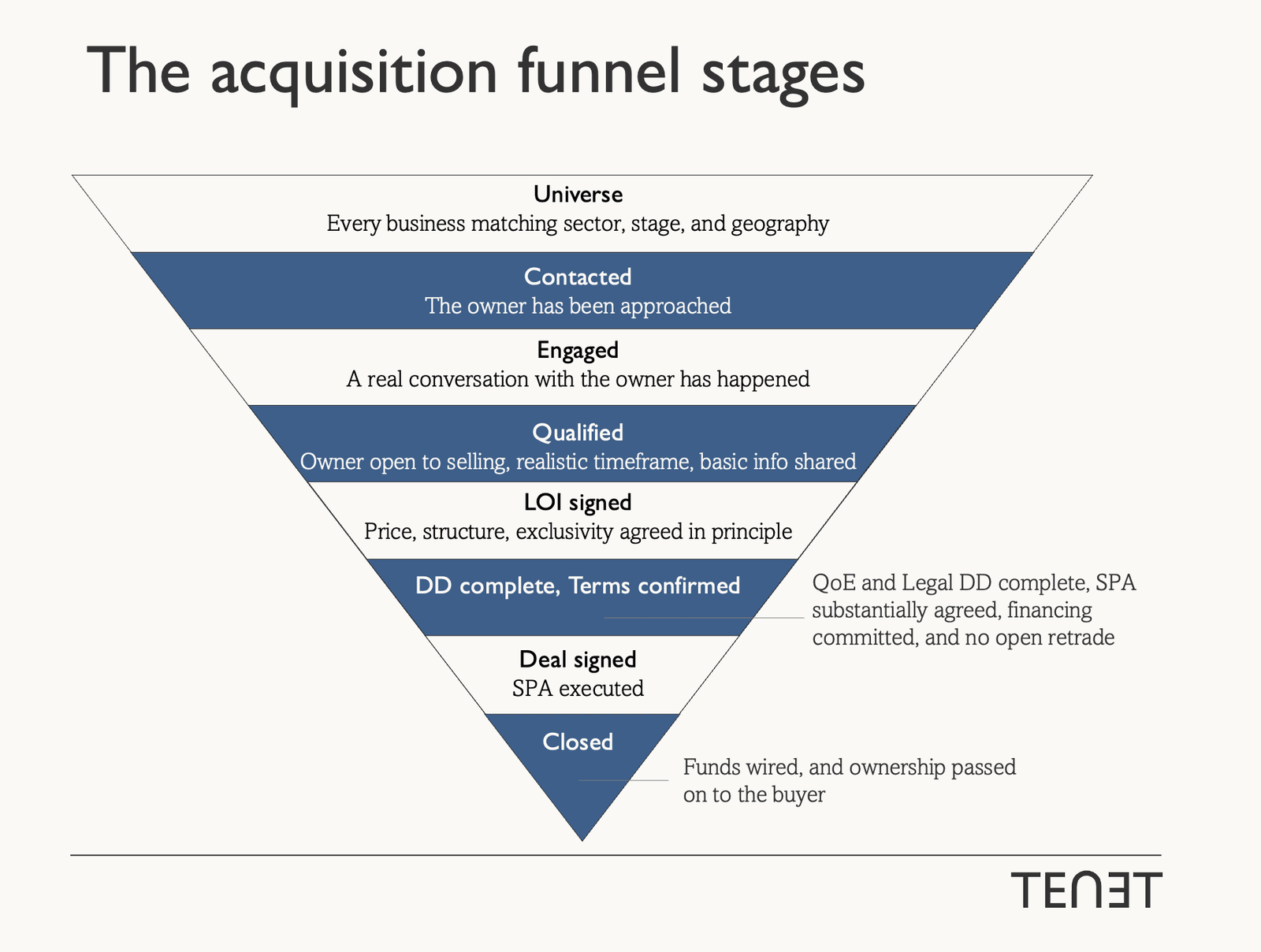
The acquisition funnel stages, narrowing from top to bottom: Universe, every business matching sector, stage and geography; Contacted, the owner has been approached; Engaged, a real conversation with the owner has happened; Qualified, the owner is open to selling with a realistic timeframe and basic information shared; LOI signed, price, structure and exclusivity agreed in principle; DD complete and terms confirmed, quality of earnings and legal due diligence complete, SPA substantially agreed, financing committed and no open retrade; Deal signed, SPA executed; Closed, funds wired and ownership passed to the buyer. (opens the image full size in a new tab)
Tap to enlarge

Approximate rules of thumb:

  • Direct outreach turns only a small share of contacts, typically low single-digit percent, into real conversations. Only a fraction of those close.
  • Proprietary deals often take 6–24 months from first contact to completion.
  • Brokered deals typically run 4–9 months from teaser to completion.

Early screening criteria that kill most deals:

  • Profit history: stable over three or more years, not a one-year spike.
  • Revenue quality: recurring or contracted revenue rather than one-off projects.
  • Owner dependence: is there a second layer of staff who manage clients and delivery without the owner?
  • Customer concentration: a single client above roughly 20% of revenue is a common flag, and can be a deal-killer unless the risk is priced in, typically through an earn-out tied to retaining that client (more on this in later chapters).
  • Fit with the platform: sector, geography and services.
  • Seller motivation and timing: real, and within a realistic window.
  • Price expectations: within range after an early valuation conversation.

Red flags at the sourcing stage:

  • Adjusted EBITDA far above the profit shown in filed accounts and a low cash conversion percentage.
  • A sharp jump in profit just before the sale.
  • Increasing EBITDA ahead of the exit but no additional cash conversion.
  • An owner who insists on all cash and an immediate exit, with no handover at all.
  • An owner who won't introduce key staff or a second-in-command at any stage.
  • A retirement story alongside declining revenue or lost key clients.
  • A business listed for a long time, or relisted with a new broker.
  • A broker running a full auction on a very small business.
  • Key clients or staff related to the owner.
  • A seller using your offer to negotiate with another buyer.

Track this: review funnel numbers every quarter: conversion between stages, time from first contact to completion, median EV/EBITDA across the funnel, and why deals were lost. Zooming out to view the funnel in aggregate often reveals a lot about pipeline quality and flags any early interventions needed.

5. Winning deals without paying the most

Even a well-sourced deal can turn competitive (although, there are fewer buyers in your target size range). Owners test your price, hire an adviser or take a call from another buyer. When that happens, it helps to know who you’re up against.

  • Other roll-ups and buy-and-build platforms in the same sector, some could be pursuing the same targets for the same reasons.
  • PE-backed platforms buying add-ons. They can justify higher prices because they price in synergies.
  • Other financial buyers, such as search funds, independent sponsors and serial acquirers. Search funds are growing across Europe, and compounders are particularly active in the Nordics.
  • Trade buyers, usually local competitors. They are often the most dangerous bidder because they already know the clients.
  • Management buyouts and family successors. Rarely the highest bidder, but sellers often favour them for continuity.

The good news is that at this size, the highest bidder doesn't always win. Owners and brokers fear deals that collapse late, and owners care about what happens after the sale. Keep them in mind during sourcing conversations, and ensure your messaging reflects this.

What wins deals:

  • High certainty of closing: funding in place, a clear process, a known timeline.
  • Speed: fast responses and a quick indicative offer.
  • Reputation and references: letting the owner speak to people who sold to you before.
  • Fit: a credible plan for the owner's staff, clients and brand, and a realistic role for the owner.
  • Flexible structure: matching the seller's personal and tax goals. For example, more cash at completion for a lower headline price, or rollover equity for an owner who wants upside.
  • A credible number. Sellers and brokers discount offers from buyers known to cut the price after diligence. An honest offer, with the EBITDA it's based on stated up front, often beats a higher one the seller suspects will shrink. It also means that if diligence does find problems, the price moves by agreed arithmetic rather than as a retrade (more on this in Chapter 2).

When losing is the right outcome: when a trade buyer with obvious synergies wants the business badly, or a PE-backed platform pays up for an add-on. Walking away is part of the job.

6. Sourcing economics

Sourcing is a fixed cost that truly pays off at volume. The team, data, outreach tools and broker relationships cost roughly the same whether you close two deals a year or ten.

  • Dead-deal costs are large relative to deal size. Legal and diligence fees on deals that fail can be significant at €0.5–2m EBITDA, which is why discipline early in the process matters.
  • Pressure to deploy capital pushes acquirers into worse deals. Be honest with yourself about whether pipeline quality is keeping pace with the deployment targets you've set.
  • Each closed deal lowers the cost of the next. Referrals, reputation and standard documents compound.

Test yourself

A quick self-check on this chapter. No sign-up, and nothing is saved or sent.

1 of 10

Question 1 of 10: After eight months of direct outreach you’re the only buyer talking to the owner of a Dutch IT services firm (€900k EBITDA). At your second meeting he mentions his accountant has suggested “getting a couple of other parties to look at it, just to see.” What’s your best move?
Part 2 of 514 min read

Chapter 2: Valuation and quality of earnings

While valuation is easy to understand in principle, establishing what a small business is actually worth is far more nuanced. A business is only worth what its underlying earnings can sustain. Yet in small-business acquisitions, the profit figure presented by a seller is rarely the number you should use to price the deal. Owner expenses, one-off costs, aggressive adjustments, and earnings that depend on the owner staying can all make a business look more profitable than it really is.

This chapter explains how to establish the earnings you're actually buying, assess what those earnings are worth, and negotiate a fair price that reflects both the opportunity and the risks.

1. How price is really set

The formula is simple: enterprise value = multiple × adjusted EBITDA. The catch is that both inputs are defined by whoever controls the conversation.

The multiple sits within a broad range for businesses of this size. Where a particular business lands depends on its growth, its profitability, how risky its earnings are, and how competitive the deal is.

But before even debating any multiple, it is crucial to pin down exactly which EBITDA it applies to. The EBITDA shared in an Information Memorandum or Management’s Accounts is rarely the one used for calculating price. Which period is used, which costs are added back, and which new costs a buyer will face can also move it substantially.

Most of the negotiating energy goes on the multiple, but EBITDA is an equally important lever, because any error in it is multiplied. On a business with €1m EBITDA priced at 5x, conceding a full turn of multiple costs €1m. Accepting €250k of adjustments that don’t hold up costs €1.25m.

2. What moves the multiple

European services businesses at <€2m EBITDA typically trade at low/mid single digit EV/EBITDA multiples, depending on sector, country and competition. Where a business lands in that range comes down to a handful of risk factors.

FactorPushes the multiple downPushes the multiple up
GrowthTopline growthFlat or declining, or growth only from price rises or one-off winsSteady organic growth over three or more years, from both new clients and price
ProfitabilityMarginBelow sector peers once normalised, or high only in the sale yearAbove sector peers on a normalised basis, consistently
Cash conversionProfit that doesn’t turn into cash: rising debtors, recurring capexMost of EBITDA converts to cash, year after year
RiskOwner dependenceOwner owns client relationships and operationsA second layer manages clients and delivery
Revenue qualityProject-based, re-won every yearRecurring, contracted, or habitual with low churn
Customer concentrationOne client above ~20% of revenueNo client above ~5–10% of revenue
CyclicalityDemand tied to the economic or property cycle, such as recruitment or construction servicesNon-discretionary or compliance-driven demand, such as accountancy or insurance
Staff and cultureHigh turnover, key people close to retirement, resistant to changeStable team, mid-career, reasonably paid, open to new ways of working
SizeCloser to €0.5m EBITDACloser to €2m EBITDA
RecordsMessy books, cash basis, owner’s headMonthly management accounts, clean CRM and client data
Deal dynamicsCompetition for the dealDirect approach, few alternatives for the sellerBrokered auction, trade buyers interested

Practical points:

  • The size discount is steep: A €2m EBITDA business often commands a full turn or more above a €0.5m one in the same sector. That gap has been the core of traditional buy-and-build economics.
  • Sellers quote the top of the range: They hear about a peer who sold for 7x, rarely that it was twice the size, growing much faster, or partly earn-out.
  • Some sectors talk in revenue, not EBITDA: In accountancy and insurance broking, sellers often anchor on a multiple of fees or commission. Convert it to EBITDA for your own discipline, but expect to negotiate in the seller’s terms: a high-margin firm at “1x fees” can be cheap, and a low-margin one expensive.
  • Separate the current value of the business from the value you will bring: Sellers might argue that your AI capabilities make the business worth more. That upside and execution risk are both yours; pricing them in means transferring the upside to the seller.
  • Set a maximum multiple before you start: Competitive dynamics might nudge you towards unjustified multiples. Disciplined acquirers have a ceiling for each type of deal, and walk away above it.

3. Normalising EBITDA: add-backs and add-downs

Normalising means “restating profit as it will look under a new owner”. Sellers present add-backs: costs they say won't continue. Good buyers test each one, then add the add-downs: costs a new owner will bear that the seller left out. The "basis" has to be settled before the adjustments mean anything.

3.1 First, settle the basis

Before testing any adjustment, agree which EBITDA you are starting from. Three questions decide it:

  • Which period? Sellers prefer a forecast or “run-rate” figure. Buyers typically start with Last Twelve Months (LTM) or the last full financial year, then adjust for the underlying trend. Where earnings are declining, investigate whether the decline is temporary or structural rather than relying on a historical average. If it is volatile, use a normalised mid-cycle EBITDA.
  • Before or after rent? Some accounting rules, such as IFRS 16, move lease costs below EBITDA, which flatters it. Deduct the rent the business will actually pay under new ownership. An owner charging little or no rent is a separate issue, covered under add-downs below.
  • What about capex? EBITDA ignores capital spending. In services it is usually low, but vehicle fleets, IT hardware and office fit-outs are real recurring costs. Check cash conversion (operating cash flow divided by EBITDA), not just EBITDA.

Field lesson: when someone quotes “5x”, ask “5x what?” A 5x on seller-adjusted, pre-rent, forecast EBITDA can be 7x or more on the real number.

3.2 Common add-backs and how to test them

Add-backSeller's argumentHow to test itUsual outcome
Owner's personal expensesCar, travel, phone and home costs run through the companyInvoices and card statements, line by lineAccept what is evidenced; reject round estimates
Family members on payrollSpouse or children paid but not neededAsk what they actually do; talk to staffIf they do real work, add back only the gap to a market salary
One-off costsLegal dispute, recruitment, office moveLook at three to five years of "one-offs"Accept only if genuinely non-recurring; "one-offs" that appear every year are running costs
Owner's salary above marketOwner overpaid themselvesCompare to the cost of a replacement managerUsually goes the other way (see add-downs)
Lost client, costs removedCosts tied to a lost contract have gonePayroll and supplier records after the lossAccept the cost saving only if the revenue loss is also reflected
New client "run-rate"A contract won recently will add profitContract, first invoices, payment historyRarely accepted in price; handle through an earn-out if at all
Undeclared cash income"Real profit is higher than the accounts"Don'tNever pay for it. It is a tax liability and a legal risk

3.3 The add-downs that are often missing

  • Replacing the owner: The single biggest adjustment. Many small-company accounts show the owner on a token salary, with the rest taken as dividends. A multiple on that EBITDA is a multiple on profit that doesn’t exist once you hire a manager. An owner on €60k salary plus dividends may need replacing with a manager costing €120–150k including employer social charges. Those charges range from roughly 15% of salary in the UK to over 40% in France.
  • Owner doing two jobs: Many owners are both managing director and the senior fee earner. That can mean two replacement hires, not one.
  • Owner's unpaid hours: An owner working 60 hours a week is often replaced by someone working 40.
  • Market rent: If the owner personally owns the office and charges little or no rent, a proper lease at market rent is a new cost. This is very common.
  • Below-market salaries: Check pay against the local market. Where long-tenure staff are paid below it, loyalty to the owner may be what keeps them. Once the owner leaves, expect either raises or departures, with replacements hired at market rates.
  • Vacancies covered by the owner: An unfilled role costs money once filled.
  • Proper finance and compliance: A monthly close, audit where required, insurance, GDPR and IT security to a standard a group needs.
  • Deferred investment: Old IT, software licences in the owner's personal name, and sometimes unlicensed software.
  • Hidden subsidies: Staff, premises or services borrowed from another company the owner controls.

Rule of thumb: if seller add-backs exceed roughly 20–30% of reported EBITDA, the adjusted figure deserves heavy scepticism. A business whose profit only exists after adjustments is a different business from the one in the accounts.

4. Patterns to watch for before a sale

Most sellers act in good faith. But owners preparing to sell naturally tend to make profit look its best in the year that sets the price. Knowing the patterns tells you where to look.

What happensEffect on the numbersWhere it shows up
Discretionary spending cut: marketing, training, maintenance, hiringProfit up in the sale year, but not sustainableMonthly cost lines drop sharply in the last 6–12 months
Leavers not replaced; owner covers the workLower staff costHeadcount falls while revenue holds
Prices raised just before saleRevenue up; client losses come after completionPrice increases in the client revenue data; churn in the months after
Invoices pulled forward, costs pushed backProfit shifted into the LTM periodSpike in revenue near the cut-off date; low accruals
Annual contracts recognised upfrontRevenue booked before the work is doneLow or no deferred income on the balance sheet
Suppliers paid late, clients chased hardCash looks strong at completionAged creditors rising, aged debtors unusually low
Costs moved to the owner's other companyLower costs in the business for saleRelated-party payments; staff paid elsewhere
Only add-backs, never add-downsAdjusted EBITDA inflatedThe broker's EBITDA bridge has only positive items
"Run-rate" EBITDA used as the basis for pricePrice based on a future no one has seenForecast months presented as achieved

The general pattern to look for: a business that suddenly got much better in the year or two before it went up for sale. Always ask what changed, and whether it will stay changed after the owner leaves.

5. Testing the numbers cheaply

A full quality-of-earnings report from an accounting firm is often disproportionate to the deal at this size. Experienced buyers do a focused version: a few checks that catch most problems, done early, with a smaller firm or in-house.

The checks that matter most:

  1. Proof of cash: Reconcile 12–24 months of bank receipts to sales invoices and the sales ledger, allowing for VAT, payment timing and movements in receivables. Investigate material unexplained differences before proceeding.
  2. VAT returns against revenue: VAT turnover provides an independent cross-check against management accounts. A gap between VAT turnover and management accounts is a serious flag.
  3. Three sets of numbers: Compare monthly management accounts, statutory accounts and tax returns. They should tell the same story.
  4. Monthly trend over 24–36 months: Look for seasonality, a spike near year-end or the LTM date, and costs that suddenly fall in the sale year.
  5. Revenue by client: Get the top 20 clients' revenue for each of the last three years. It shows concentration, churn, and whether growth came from price or volume.
  6. Payroll against the P&L: Match the payroll report and headcount list to staff costs. Check who is on payroll and what they actually do.
  7. Aged receivables: Old unpaid invoices may never be collected, which means revenue was overstated.
  8. Aged payables: Suppliers paid unusually late flatter the cash position before a sale.
  9. Accruals and cut-off: Holiday pay owed, bonuses earned but unpaid, annual fees invoiced upfront. These move profit between periods.
  10. Related-party transactions: Anything paid to or received from the owner, their family or their other companies.

Field lesson: Sequence your requests. Before an LOI, ask for what a seller can reasonably share under NDA: filed and management accounts, VAT return totals, and revenue by client with names anonymised. Bank statements reveal clients, suppliers and staff pay, so most sellers will only share them after an LOI and exclusivity. Ask for them first once those are signed, so proof of cash is done in the first weeks of the red-flag review. A seller who still hesitates at that point is worth a closer look.

6. Worked example: seller's EBITDA vs buyer's EBITDA

In this illustrative example, the seller and buyer agree on a 5x multiple but end up almost €1.6m apart on price. The whole gap comes from the EBITDA definition.

The business is a regional accountancy firm with €950k reported EBITDA. The broker's information memorandum presents €1.23m adjusted EBITDA.

Item (€k)Seller's viewBuyer's viewWhy the buyer differs
Reported EBITDA950950Agreed; matches the accounts and bank statements
Owner's personal expenses+60+40Only €40k is evidenced by invoices
One-off legal dispute+50+50Settled, and no similar costs in prior years
Spouse on payroll+70+30They do real admin work; replacing their costs about €40k
New client, run-rate+1000Signed three months ago; no track record yet
Replacing the owner0−70Owner takes €60k salary; a manager costs about €130k including employer charges
Market rent0−45Owner owns the office and charges no rent; a lease will be needed
Vacancy covered by the owner0−40A senior bookkeeper left last year and wasn't replaced
Adjusted EBITDA1,230915
Price at 5x6,1504,575Gap: €1,575k

Some insights that this example illustrates:

  • The buyer's adjusted EBITDA is below the reported figure. This is common when the owner is underpaid and rent-free.
  • Conceding a whole turn of multiple doesn't close the gap. The seller's EBITDA at 4x is €4.9m, still above the buyer's €4.6m at 5x. Arguing about the multiple while accepting the seller's EBITDA is the classic mistake.
  • The disputed new client is a structuring question, not a price question. If it proves real, an earn-out can pay for it later. Chapter 3 covers this.

7. From headline price to cheque: debt-like items

The headline price is enterprise value, on a cash-free, debt-free basis. What the seller actually receives is equity value: enterprise value, minus debt and debt-like items, plus surplus cash. Sellers focus on the headline; experienced buyers pay particular attention to the bridge as it can materially change the final consideration.

Debt-like items are obligations that exist at completion but aren't labelled as debt. Typical ones at this size:

  • Unpaid corporation tax on profits already earned.
  • Deferred income: fees billed in advance for work not yet done. You inherit the work without the cash.
  • Accrued holiday pay and earned bonuses not yet paid.
  • Loans from the owner or family to the company.
  • Overdue supplier payments beyond normal terms.
  • Deferred VAT or payroll taxes, including arrangements left over from pandemic-era schemes.
  • Dilapidations: the cost of restoring leased premises at the end of the lease.
  • Known claims or disputes likely to cost money.

Note: The classification of these items is not fixed. It is negotiated and must be consistent with the working capital definition. An obligation should not reduce the purchase price twice, once as a debt-like item and again through the working capital adjustment.

Continuing the example (€k):

Bridge itemAmount
Enterprise value (buyer's view)4,575
Bank loan−200
Unpaid corporation tax−80
Deferred income−120
Accrued holiday pay and bonuses−40
Loan from owner to company−60
Surplus cash above normal needs+150
Equity value paid to seller4,225

Two practical points:

  • Agree the principles for debt-like items in the LOI. You can’t list every item before diligence, but you can agree the price mechanism, how known material items are treated, and how anything found later will be classified. Leaving it all to the purchase agreement invites a late fight that feels like a price cut.
  • "Surplus" cash is only cash above what the business needs to operate. The level of working capital the business needs is set by a target (the "peg"), covered in Chapter 3.

8. How the valuation conversation actually works

Good acquirers negotiate the method before the number. Once the seller agrees how EBITDA is defined, the price mostly follows, and later changes feel like arithmetic rather than a retrade.

How experienced buyers run it:

  1. Find the seller's real number early. Many owners don't really care about the multiple. They have a figure in mind, often cash in the bank after tax that funds their retirement, such as "I need €3m net". Structure to that figure, not to their headline expectation.
  2. Walk the seller through your EBITDA bridge in person. Show each adjustment and why. Owners who understand the logic accept lower numbers far more readily than owners handed a figure.
  3. Bring the seller's accountant in. They will explain your adjustments to the owner in terms the owner trusts, or tell you where you are wrong.
  4. Write the EBITDA basis into the LOI. State the price as a multiple of a specified adjusted EBITDA, with the main adjustments listed. If diligence finds EBITDA is lower, the price moves mechanically. This is the single best protection against both overpaying and being accused of retrading.
  5. Separate agreed value from disputed value. Pay for the agreed EBITDA at completion. Put disputed items, like a new client or a recovering trend, into an earn-out or deferred payment.
  6. Never argue the multiple against a broker's comparables. Brokers will cite deals you can't verify. Argue from this business's specific risks instead.
  7. Don’t attack the seller’s dignity. Criticising the business to justify a lower price damages the relationship you need for the handover. Frame adjustments as "what a new owner will have to pay", not "what's wrong with your company".

Signals worth reading:

  • A broker's "guide price" is usually the top of what the seller hopes for, not what they'll accept.
  • A seller who moves quickly off their number was probably anchored on hearsay. A seller who won't move at all may not be ready to sell.
  • An owner asking detailed questions about the handover period and staff is usually a serious seller.

Test yourself

A quick self-check on this chapter. No sign-up, and nothing is saved or sent.

1 of 10

Question 1 of 10: Seller presents €1.5m adjusted EBITDA at 5x (€7.5m). It includes €200k “run-rate” from a contract signed two months ago. The owner takes a €50k salary; a replacement manager costs €140k including employer charges. The owner owns the office and charges no rent; market rent is €60k. Everything else checks out. What’s your price at 5x?

Notes

  1. “Nachfolge-Monitoring Mittelstand 2024”by KfW 2025 ↩

Important notice

This guide is provided for general educational and informational purposes only. It is a compilation of practices and lessons that experienced acquirers have found useful. It is not a set of rules, and it does not prescribe how any particular transaction should be done. Every business, seller and deal is different, and what works in one situation may be wrong in another.

Nothing in this guide is legal, tax, accounting, financial or investment advice, and it should not be relied on as such. Legal and tax points are simplified and directional. They vary by country, change frequently and depend heavily on the specific facts. Before acting on anything in this guide, take advice from qualified professionals in the relevant jurisdiction who can consider your circumstances. Reading this guide does not create an adviser–client or any other professional relationship.

Worked examples, figures, multiples, cost ranges and timelines are illustrative. They are based on practitioner experience and rules of thumb, not on verified market data, and should not be treated as benchmarks. The content reflects the authors' understanding as of October 2026. It may become out of date, and we are under no obligation to update it.

To the fullest extent permitted by applicable law, Tenet Management I GmbH and its partners, employees and affiliates, AI Roll-up Nexus, and the contributors to this guide accept no responsibility or liability for any loss or damage arising from the use of, or reliance on, this guide or any part of it. The views of individual contributors are their own and do not necessarily represent those of their firms or of Tenet.

References to third-party firms, publications or resources are for information only and are not endorsements. This guide is not an offer or solicitation to buy or sell any security or to invest in any fund or company.