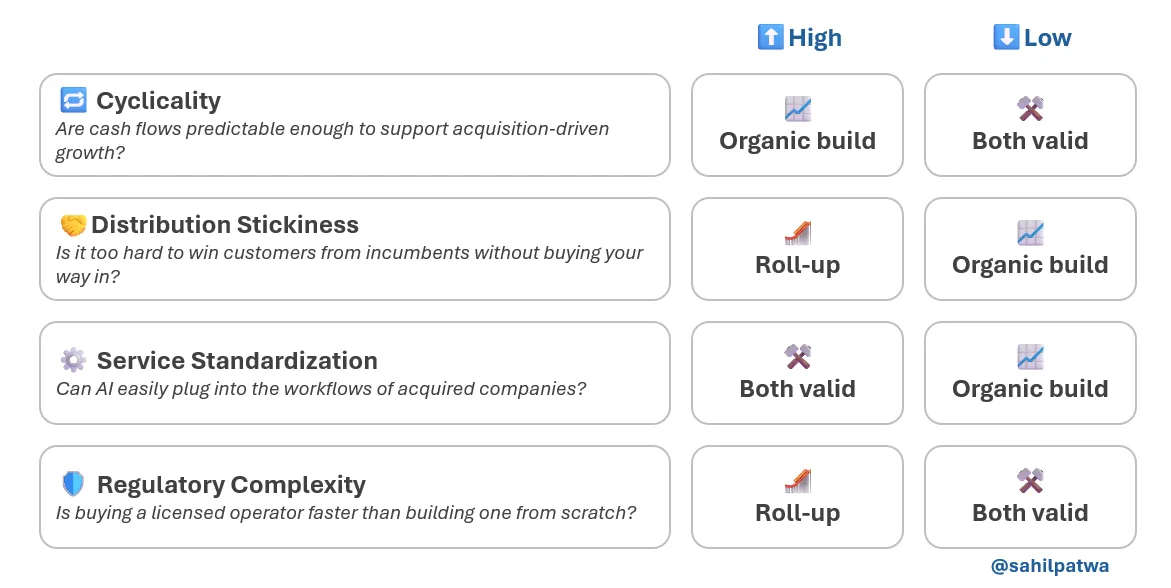
As AI capabilities expand across traditional service industries, founders face an important strategic decision: should they build an AI-powered services company from scratch or scale by acquiring existing businesses through roll-ups? The right approach depends heavily on the underlying characteristics of the market.
A useful framework for evaluating this decision focuses on four key factors: cyclicality, distribution stickiness, service standardization, and regulatory complexity.
The framework
The first factor is cyclicality. Roll-up strategies rely on predictable cash flows to support debt financing and ongoing acquisitions. Highly volatile industries can make leveraged expansion risky. In such cases, building an AI-native services company organically may offer greater flexibility, allowing the business to scale infrastructure and costs dynamically as demand shifts.
Second is stickiness of distribution. In markets where customers rarely switch providers, acquiring existing service companies can be the most effective way to gain market access. Buying established businesses effectively provides built-in distribution channels that would otherwise take years to develop organically.
The third factor is service standardization. AI systems work best when applied to structured, repeatable workflows. If companies within an industry operate in highly standardized ways, acquisitions can often be integrated into a common operating model. In contrast, industries where service delivery is highly bespoke may be better suited to an organic build approach.
Finally, regulatory complexity can strongly favor roll-ups. In regulated sectors, acquiring licensed or compliant businesses can dramatically accelerate market entry by providing existing certifications, compliance infrastructure, and institutional knowledge.
Taken together, these four criteria help founders determine whether the most effective strategy is to build a new AI-powered services platform organically or scale rapidly through acquisitions. Importantly, the initial strategy does not necessarily determine the long-term path—many companies combine both approaches as they grow.