Over a year ago, I shared a financial model to test out whether AI Roll-ups could be an outlier financial strategy. Today we are sharing one you can actually use to build.
When I published our early model, I was upfront about what it was and wasn't. It was a simplified scenario-testing tool: could you acquire several fragmented services businesses, transform them using AI, and generate returns that justify the complexity? The answer was "yes" under a range of assumptions. But the model was always meant to be more a proof-of-concept than practitioner-grade.
At Tenet, we recognize that the gap between a model that proves a thesis and a model that helps run an AIPRO business is significant.
From scenario testing to actual planning
My partner at Tenet, Alex, brings a very different vantage point to financial modelling. He spent years at Clearsight Investments, operating deep in the buy-and-build world. He thinks of models the way a CFO does: as a budgeting and business planning tool. A living instrument that tracks real assumptions against actual outcomes. The model he's built is constructed from the ground up, based on actual planning models used in the micro-PE space.
Today, we are open sourcing this model for all AI Roll-up founders.
You can access an interactive version of the model here or download the full Excel model for more granular assumptions using the link here.
About the financial model
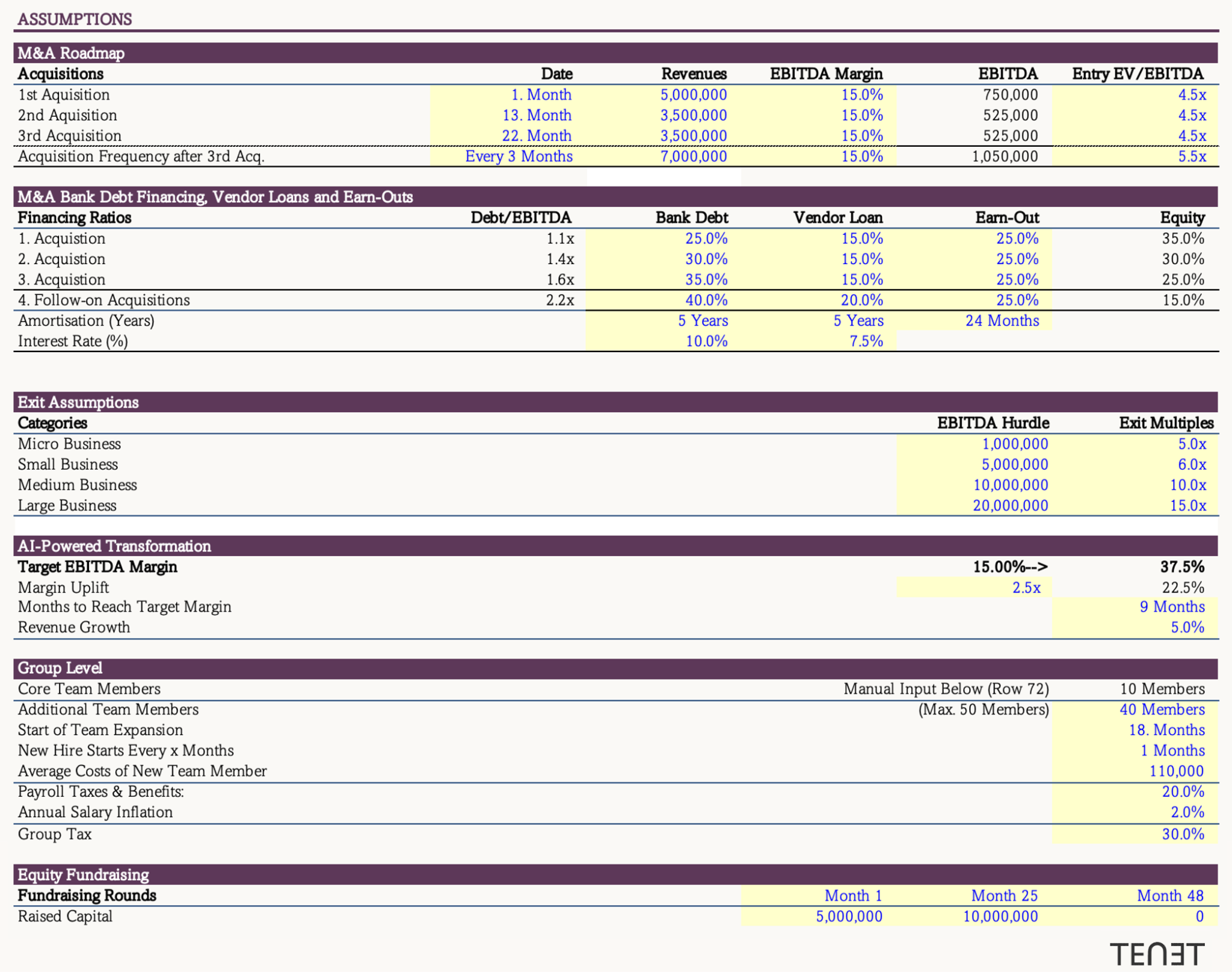
We've designed this spreadsheet model to enable you to actually run your business planning. It covers the full lifecycle of an AI Roll-up, with all the knobs and dials that a founder will care about when it comes to planning and budgeting.
For example:
- Choose the frequency, size, margin profile, and EBITDA multiples of your acquisitions
- Granularly define your team scaling profile and costs
- Built-in controls for debt capacity levels
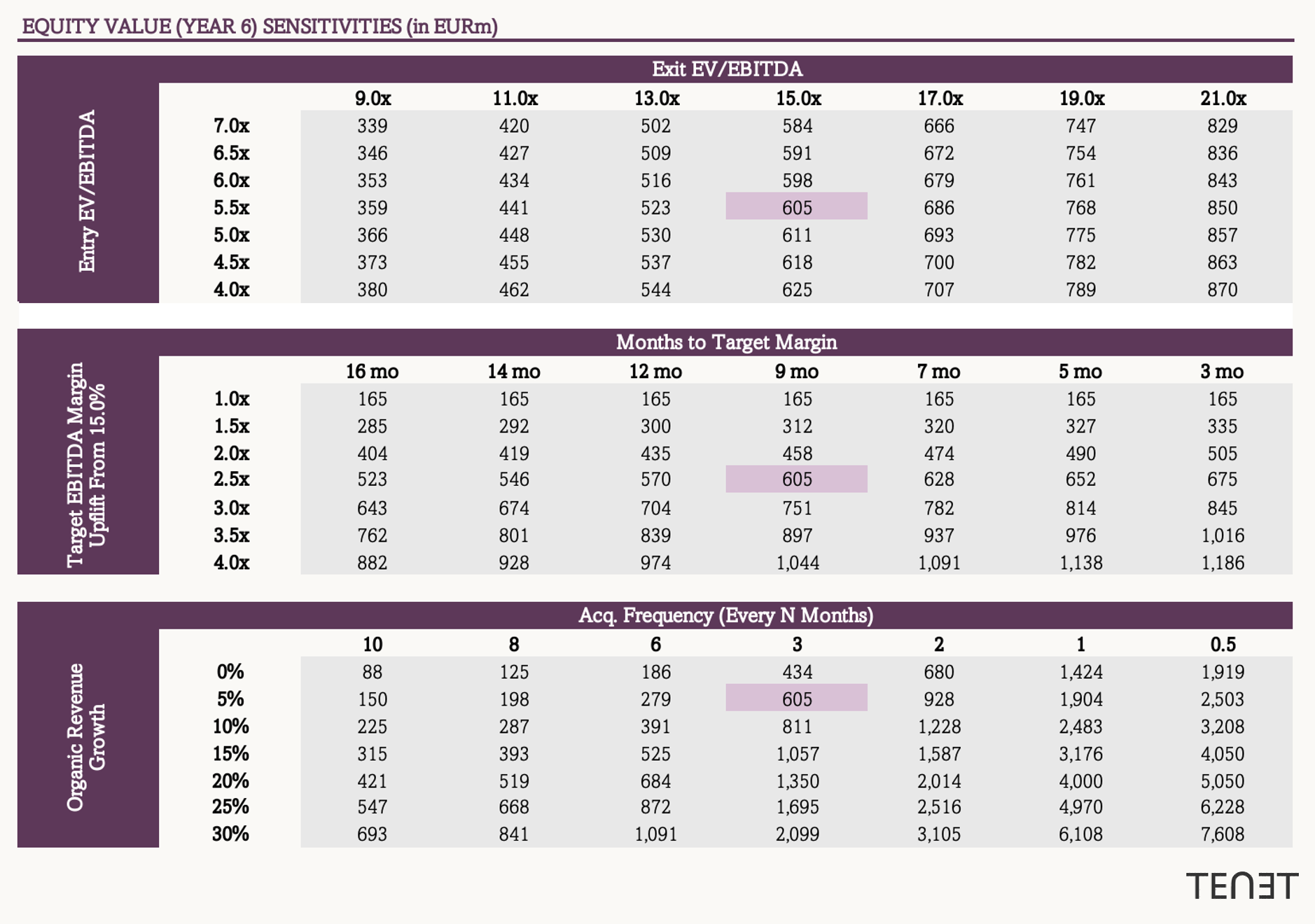
- Explore sensitivities across key input assumptions
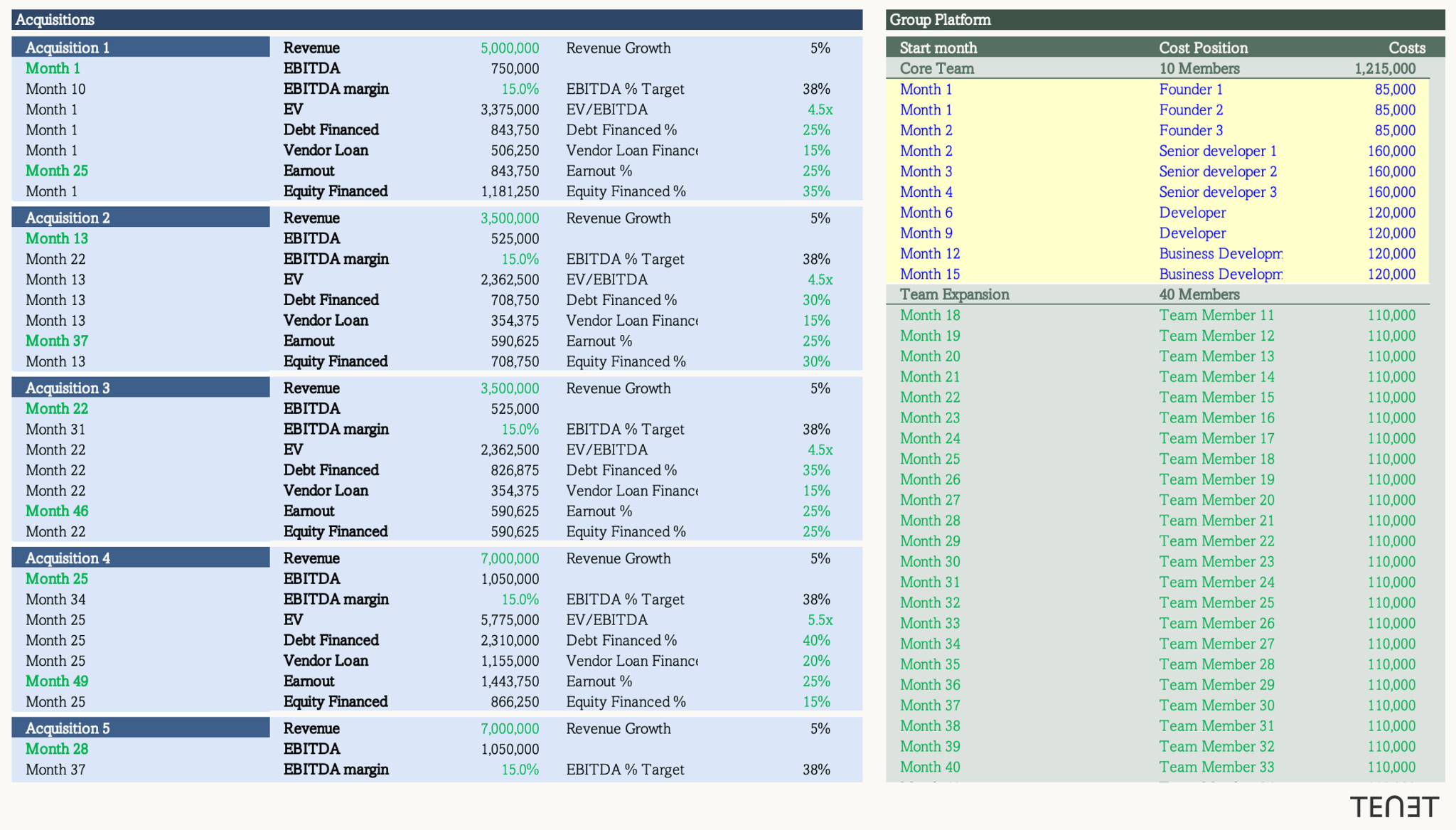
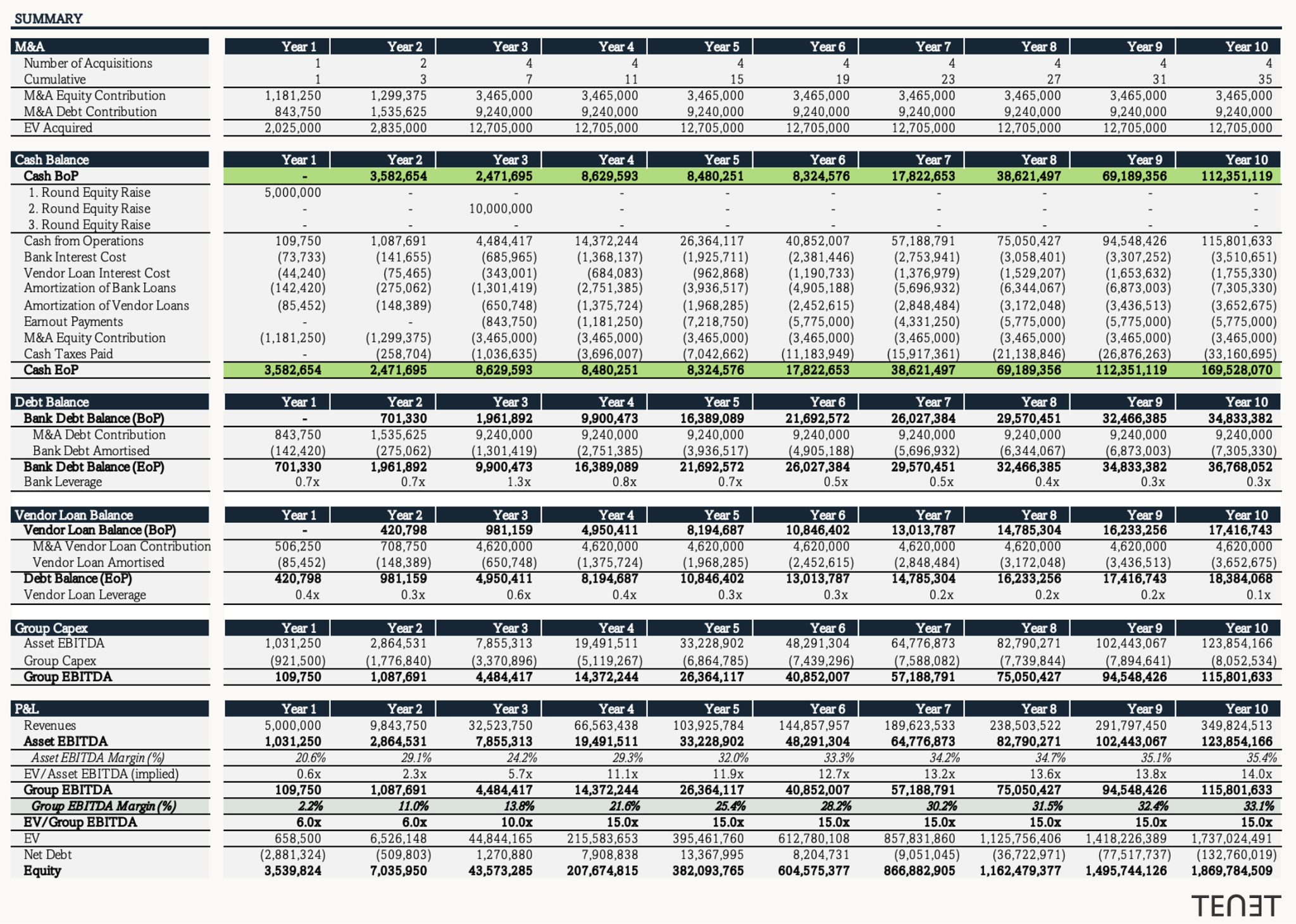
The overall philosophy has been to make it as granular as needed, without being so complex that it's not useful.
Why did we create the model?
We built this model and are sharing it publicly because we believe that AI Roll-up founders deserve better than starting with a blank spreadsheet (and Claude for Excel 😉). We saw several founders repurposing generic SaaS financial models, which are not sufficient to capture the full complexity of building an AI Roll-up (Debt Mechanics, Margin Expansion, Organic vs Inorganic Growth, Working Capital etc.) — hopefully this model serves as a good starting point and saves a few weeks of effort. We also hope this model helps expose founders to some additional parameters that they might not have thought of before.
Read Me: some caveats before you use the model
The model ships with illustrated numbers, pre-populated throughout: it's easier to react to a number than to conjure one up from nothing. But treat every pre-filled assumption as a provocation, not a recommendation. Replace them with your own numbers before you share this further. A model is only as useful as the inputs behind it, and of course the inputs are yours to validate. Garbage in, Garbage out holds here as well 😊
Of course, no model can survive an interaction with the real world, and the same is going to hold true for this as well. What the model can do is give you a rigorous structure to make those calls and track them over time.
What's next?
We plan to keep this model updated based on feedback and inputs from founders. We will keep releasing versions (with changelogs) every time there are significant updates to ship. We really enjoyed simulating various scenarios on this model internally, and would love to share some observations in subsequent posts.
For now, please kick the tires with this spreadsheet, and if you have any questions or feedback, please reach out directly to Alex (LinkedIn) or me (Twitter / LinkedIn).