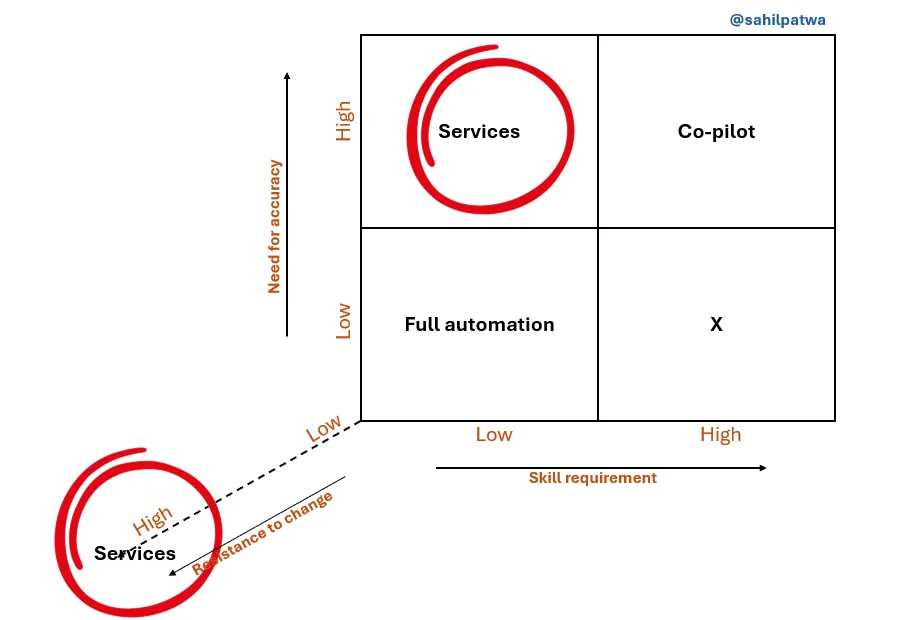
As AI transforms traditional service industries, many founders are moving beyond selling software and instead building AI-native service providers that combine technology with operational delivery. While the technology advantage is important, success in these markets ultimately depends on two factors: winning distribution and building a durable competitive advantage.
Winning Distribution
AI-native services often compete against incumbents that already control customer relationships. To overcome this challenge, founders can use several distribution strategies.
One approach is to turbocharge go-to-market using AI, enabling faster response times, automated lead qualification, and more efficient sales processes than traditional service providers. Another is delivering a dramatically superior offering—not just incremental improvements, but services that are significantly faster, cheaper, more accurate, or capable of handling much larger volumes.
Some companies can also benefit from temporary demand-supply imbalances in the market. Regulatory changes or sudden spikes in demand can create opportunities for new AI-enabled entrants to gain customers quickly. Finally, founders may choose to acquire distribution through roll-ups, purchasing existing service businesses and then improving operations with AI.
Building Durable Advantage
Early distribution wins are not enough. Long-term success requires strategic advantages that compound over time.
Several sources of durable advantage are particularly relevant for AI-enabled services. Network effects can emerge in marketplaces or platforms where participation on one side attracts more participants on the other. Reputation and marquee clients can also serve as powerful signals in industries where credibility matters more than scale.
Other advantages come from access to specialized human talent, especially in fields where expertise or certifications are scarce. Companies may also build defensible positions through proprietary workflows and operational processes, where the combination of technology, processes, and people creates hard-to-replicate performance advantages.
Finally, data flywheels—though harder to build in practice—can improve AI systems over time through better training data and feedback loops.
Together, these strategies highlight that while AI changes the tools available to service companies, many of the most durable advantages still resemble traditional services moats.